
This article is reprinted from the latest issue of Peace Researcher, No 71, August 2026. The whole issue is available as a PDF (see link below). It always has fantastic anti-imperialist research, like the article reprinted here with their kind permission.
https://www.converge.org.nz/abc/peace-researcher-home.html
By David Small
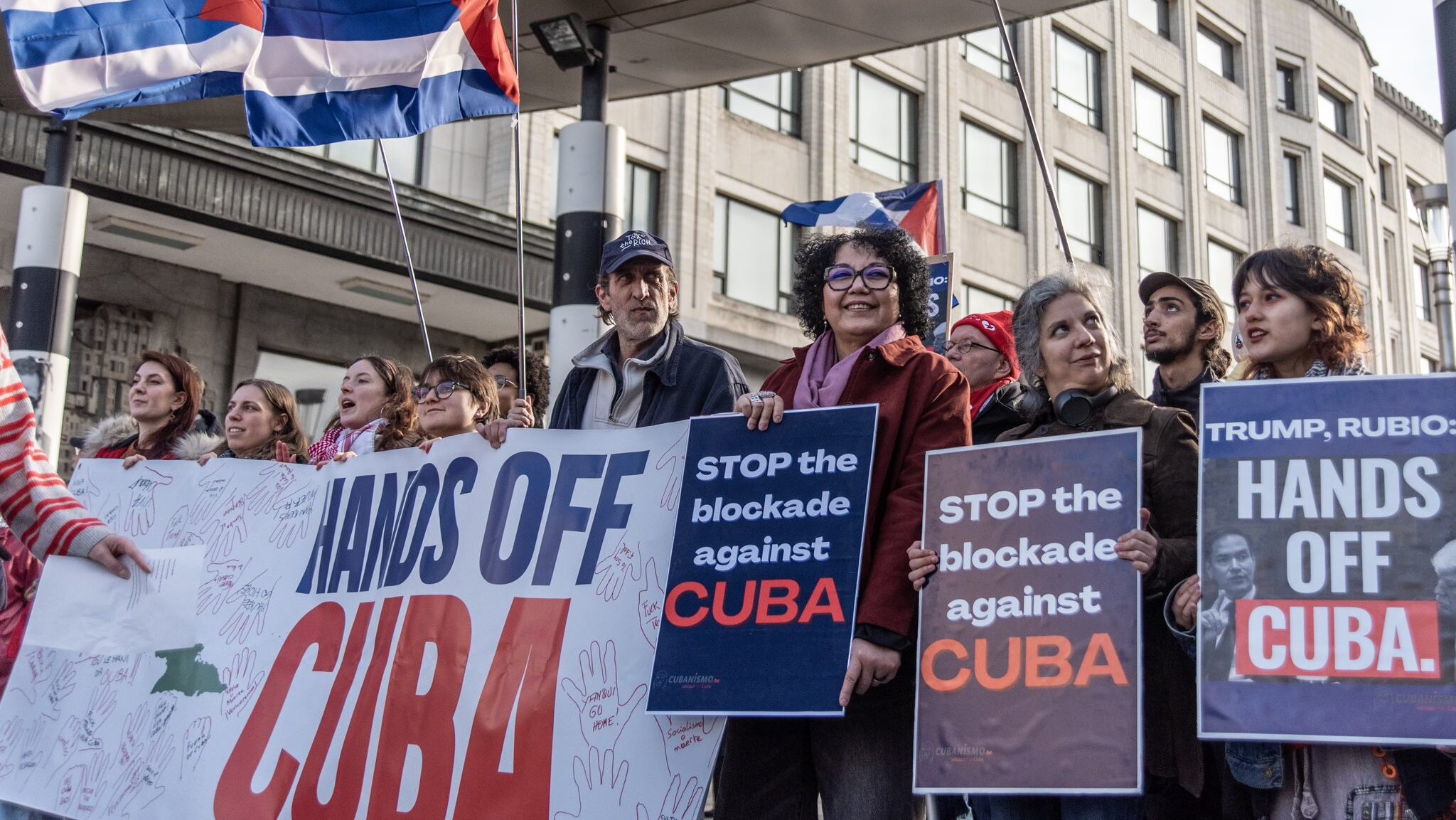
As the United States tightened its stranglehold on Cuba with ever-intensifying blockades and threats of military intervention, New Zealanders for a Democratic Economy organised an early 2026 information and solidarity meeting in Ōtautahi/Christchurch featuring Luis Morejon Rodriguez, the Cuban Ambassador to Aotearoa/New Zealand. I was asked me to join a panel and speak about the shifting geopolitical landscape. This article is based on that speech.
For my entire life, Cuba has been an inspiration to the world. Through a successful revolution in 1959, the Cuban people were able to liberate themselves from extreme exploitation and domination. Equally impressively, they have been able to sustain that revolution for decades in the face of extraordinary opposition from the US and its allies – economic sanctions, military aggression, and constant political pressure.
The form of neocolonial exploitation the Cuban revolution overthrew was common to countries of the Global South. Small corporate elites, in conjunction with the structures of US imperialism (US Central Intelligence Agency [CIA], National Endowment for Democracy, USAID etc) imposed economic systems of exploitation that favoured global capital at the expense of the local people. They enforced their domination using extreme forms of violence.
For decades, peasants, workers, fisherfolk and farmers throughout the Global South would organise in groups, at great personal risk, to demand political, economic and cultural rights. Where these democratic forces managed to defeat the elites in elections, they would often see the Governments they formed overthrown in CIA-sponsored coups.
In many countries, revolutionary movements sought to emulate Cuba’s success in overthrowing the elites by force but most were unable to achieve this. In Nicaragua, the Sandinistas staged a successful revolution in the late 1970s, but their Government eventually fell under the weight of the political and economic isolation, US-sponsored military sabotage and breaches of international law they were subjected to.
Neoliberalism And The Political Economy Of The Unipolar Era
With the collapse of the Soviet Union, the US emerged as the sole global superpower. Its power was unrivalled and, in many respects, irresistible – politically and militarily and economically. The US never shied from exerting its power on the global stage establishing itself as the authority in making the rules the world should live by and enforcing those rules.
Although the US could always count on the support of its Western allies, it was the US who called the shots. This was the dawn of the unipolar era. Central to the unipolar world was the imposition of a political economy based on neoliberalism. This model of deregulated capitalism became dominant in the countries of the industrialised West and was forced on countries of the Global South.
Through institutions like the International Monetary Fund (IMF) and the World Bank, the US and its allies weaponised the indebtedness of countries of the Global South in order to prevent them from determining the most appropriate development strategies for their own countries. The debts would be rescheduled by the IMF and World Bank only if these countries agreed to adopt a package of economic and social reforms known as “structural adjustment policies”.
This suite of neoliberal policies that countries were forced to adopt required them to open their economies to maximum penetration and exploitation by global capital – floating their currencies, removing tariffs and subsidies, privatising public assets, corporatising social services, cutting spending on health, education, welfare etc…
The plan was to create a deregulated global economy that would allow capital to move freely across national borders; to settle wherever it could find maximum possibilities of exploitation. Capital also required the flexibility and power to relocate at the first sign of trouble, be it worker rights, environmental safeguards or unfavourable tax changes.
Since colonial times, national economies had been organised so that they would favour the development of the colonial power at the expense of the well-being of the colonised people. However, neoliberal globalisation greatly intensified the possibilities for this form of exploitation. It also significantly weakened the political power and autonomy of nation states and effectively undermined their economic sovereignty.
Throughout the Global South, economies became beholden to the whim of international capital and financiers. For decades, we saw the intensification of this process of exploitation and extraction. The political and economic systems that neoliberalism promoted saw an ever-greater transfer of wealth from the poor to the rich. As this economic model became more and more entrenched, the level of inequality between rich and poor increased dramatically. This process that saw the rich and powerful enhanced their positions at the expense of the poor and powerless could be seen both between countries and within them as well.
Militarisation In The Unipolar Era
At the same time as the collective West was pushing these systems of economic exploitation, the US was also flexing its military muscle. The first big military confrontation of the unipolar era was the first war on Iraq (1990-91) codenamed “Operation Desert Storm” launched in response to Iraq’s invasion of Kuwait.
Backed by the collective West, the US demonstrated for the first time a new arsenal of high-tech “smart weapons”, notably the Tomahawk missile, which could deliver massive explosive power with far greater accuracy than ever before. These new-generation weapons could be fired from distance minimising casualties among those who wielded them with censors delivering choreographed images of the war directly into people’s living rooms around the world.
On 11 September 1990, at the beginning of the conflict with Iraq, US President George Bush the First declared the birth of a “New World Order”. Later that year, Foreign Affairs published an article defining the emergence of this new post-Cold War era as “the Unipolar Moment”. Eleven years to the day after the New World Order announcement, the World Trade Centre in New York was attacked. President George Bush the Second responded by declaring a global “War on Terror” insisting that the whole world take a side: “either you are with us or you are with the terrorists”.
The War on Terror led to the scope of State surveillance and military attack being broadened to include any country, group or person deemed to be a threat to US or Western interests. It formed the backdrop to the invasion of Afghanistan in 2001 and the second invasion of Iraq in 2003, under the (now disproved) pretext that Iraq possessed weapons of mass destruction that could be passed on to terrorists. The War on Terror also led to significant restrictions on civil liberties as intelligence agencies and police were given extensive new powers of surveillance and detention of dissidents throughout the Western world.
Although it was unable to maintain post-invasion control in countries like Afghanistan and Iraq during the unipolar era, the US had the power to destroy countries and effect “regime change” almost at will. Further, it could count on its Western allies to lend political and military support. It was during this period that alliances like Five Eyes (US, UK, Canada, Australia and New Zealand) came out of the shadows and started publicly offering political support to this project. The world was in a period of unipolar power, where the United States was the sole superpower, the sole hegemon in the world.
It advanced its economic interests by pushing neoliberalism. And it advanced its political and strategic interests by its overwhelming military power. The US made the rules. It required the rest of the world to follow the rules, and if it perceived any risk that these rules might be questioned or transgressed, it could use its overwhelming military power to force the transgressor back into line. This is the essence of the model of global domination and control that was packaged and promoted by Establishment media as the “rules-based order”. In recent years, however, this unipolar world with the US as the global hegemon has started to unravel.
China And The Economics Of Multipolarity
The biggest economic challenge to the Unipolar world is China. One of the few countries in the world where the US was unable to impose neoliberalism, China did not lose its sovereign ability to control the direction and strategies of its economic development. By avoiding the debt trap that disempowered much of the Global South, China was able to choose strategies that were designed to assist its own developmental interests – economically, socially, scientifically, environmentally, educationally and strategically.
Relying on a State-led model of economic development (the exact opposite of that being pushed by neoliberal dogma), China developed a strong industrial and later high-tech manufacturing base that led to massive increases in economic growth. Coupled with social policies, this in turn lifted 800 million Chinese people out of poverty. Most importantly, the Chinese model ensured that it was not vulnerable to the vagaries of international markets, the manipulative practices of hedge funds run by Rightwing billionaires, or the pressure, bullying and domination of the United States.
When Japan had started to emerge as an export-led economic superpower, it was stymied by the Plaza Accords in 1985. Unable to repeat this manoeuvre with China, the US tried instead to impede China’s development by imposing a combination of economic sanctions, technological boycotts, and political pressure. It also enlisted the support of its Western allies to isolate and contain China.
On 1 April 2025, President Donald Trump declared Liberation Day by announcing sweeping tariffs on most countries in the world, including American allies. Countries that had been locked into the neoliberal model were extremely vulnerable to this sort of pressure, with many of them forced to buckle. However, China had become sufficiently economically robust that it stared down the US threats.
Later in 2025 after the Asia Pacific Economic Cooperation (APEC) meeting in Busan (South Korea), Trump had a meeting with China’s President Xi and was forced to back down. After imposing tariffs on China of 145% just months earlier, Trump ended up agreeing a tariff rate of just 15%, the same as that imposed on the European Union (EU), who are US allies. Trump also agreed to get the Netherlands government to return the multi-billion-dollar Chinese company Nexperia that they had seized at the urging of the US.
Xi threw Trump a few soybean purchases (China’s retaliation had been to refuse to buy US soybeans) so that he could pretend it wasn’t a backdown. But everybody knew it was. One issue in particular had forced the backdown – China’s control of rare earths that the US depends on for its high-tech and armaments production. China agreed to suspend its rare earths export ban, but only for a period of 12 months. Watch this space!
This marked a major turning point in world economics in the multipolar era. The US and China have ended the universal hegemony of neoliberalism. Trump abandoned it with his Liberation Day tariffs. China showed how much it had prospered by eschewing neoliberal ideology. And the Busan meeting illustrated the demise of neoliberal economic model underpinning the unipolar world. The country with the world’s strongest economy was publicly out-muscled by a country which used to have one of the world’s poorest economies. China had gained strength through its rejection of neoliberalism.
It had also worked with other countries of the Global South to construct alternatives to the US-dominated global economy through initiatives such as BRICS*. China had consciously protected itself from US economic attack and developed a capacity and readiness to retaliate. *BRICS is a bloc headed by Brazil, Russia, India, China and South Africa, along with a number of other member countries and partners. Ed.
In May 2026 China activated two economic statutes against its Western adversaries. One, aimed at undermining sanctions against Iranian oil, made it illegal for any company to comply with US economic sanctions in its dealings with China. The other prohibited Chinese companies from complying with foreign subsidies probes by European Union investigators. As with US sanctions, China is applying both of these laws with extra-territorial effect.
The End Of Unipolar Political Authority And Military Power
Economically, the end of the universal hegemony of neoliberalism came with China becoming too economically powerful and self-reliant, to be forced into submission. Politically, the beginning of the end of the unipolar era happened in Gaza. It was the inhumane, depraved murderous, indefensible, genocide in Gaza that fundamentally altered and, I think, permanently destroyed any moral authority that the collective West might have previously had.
While the whole world was watching the genocidal slaughter, Western leaders were trying to convince us that what we could see was not actually happening or to justify it. Besides all the other grotesque elements of Israel’s genocide and war crimes, we witnessed an extraordinary attempt at global gaslighting; one that failed completely. As the genocide continued it became impossible for Western leaders, even in the US itself, to convince people that the Israelis were the goodies and the Palestinians the baddies.
Ultimately, one of the Western leaders, Canadian Prime Minister, Mark Carney, broke ranks and let the cat out of the bag. In his speech to the World Economic Forum in Davos, Carney confessed that everything progressives had been saying over the last decades was correct. He admitted that the political, economic and military objectives of the collective West have actually been designed to advance their own interests at the expense of the poor and the weak. Carney told the world that Western elites were only ever pretending to stand for democracy, freedom and justice to disguise their true objectives of advancing their own interests.
And then there is the US/Israeli war against Iran. Although there may be a range of reasons why Iran was attacked, the Carney confession has made one thing clear: It had nothing to do with advancing the rights or the well-being of the people of Iran. It was clear from the US failure to defeat Ansar Allah (the Houthis) in Yemen, Israel’s inability to destroy Hamas in Gaza and their desperate pleas for a ceasefire in June 2025 that Iran could not be defeated militarily.
Predictably, therefore, the US has proved thoroughly unsuccessful in seeking to effect “regime change” in Iran despite massive bombing raids, assassinations and the unfounded hope that the attacks would spark a popular uprising. Instead, the US is stuck in a quagmire that is costing its Western allies more and more with each passing day, and which is sending the global economy into a tailspin. At the same time, it appears that the conflict is strengthening economic, political and military ties between key actors in the emerging multipolar world, the West’s adversaries of China, Russia and Iran.
The damage caused by the US failure in Iran is also undermining the Trump regime’s attempts to secure support from its erstwhile Western allies. Unlike during earlier conflicts, these countries are now both unable and unwilling to engage militarily in the war against Iran. What we are seeing in Iran is the end of US military hegemony.
During the Unipolar era, the US was able to destroy countries by attacking, causing massive damage, toppling Governments, and then leaving them in a mess – as it did in Iraq, Afghanistan and Libya. In most instances it could inflict this destruction without suffering significant damage itself. Since the Unipolar Moment, the US has been so dominant that even the threat of attack would usually suffice.
Trump thought he could do this to Iran as well, expecting to achieve the destruction of the Iranian state within a matter of days. But he failed dramatically. Operation Epic Fury has become Operation Epic Fail. The US will not achieve its objectives, and the longer it persists with this war and fails to find an off-ramp against an Iran that is well aware that it holds all the cards, the worse the outcome for the collective West will be.
Transition To A Multipolar World Order
With failure in their conflicts against China, Palestine and now Iran, the group many have labelled the “Epstein West” is losing its grip on power and being overtaken by the emergence of a new world order, a multipolar world order. The US is no longer the uncontested power of the world. The Epstein West have lost their political standing and moral authority. They have lost their economic domination. And they have lost their military invincibility.
It is not yet clear what form this transitioning from a unipolar world to a multipolar world will take. But one thing is clear; it will be led by countries of the Global South. Although not a homogeneous block, we can see in the Global South attempts to build and maintain genuine alternatives to the current political and economic models, all of which have their origins in colonial domination and exploitation. Cuba is a key part of this emerging counterweight to the Epstein West. Alongside Palestinians and Iranians, Cubans are the heroes of the resistance before, during and after the Unipolar era. Cuba has defied US imperialism and given people hope and inspiration.
Cuba has consistently stood with and supported people in struggle throughout the world, notably in South and Central America, Southern Africa, and West Asia. The Cuban people have endured, enormous suffering, but stood up against aggression from the US and its allies while maintaining an extraordinary internationalist orientation. Right now, however, Cuba is in the crosshairs. After Trump’s back-down in Busan, the US released a National Security Strategy where it emphasised that its main priority will be the domination and exploitation of the Western Hemisphere to the exclusion of “non-Hemispheric competitors”.
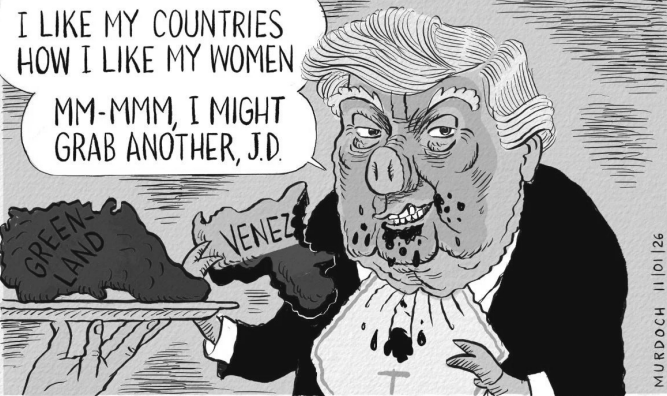
Named the “Trump Corollary” to the 1823 Monroe Doctrine, this spheres-of-influence model of geopolitics was displayed with the US kidnapping of Venezuelan President Nicolas Maduro and his wife in January 2026. The following month, in a triumphalist speech to the Munich Security Conference, US Secretary of State Marco Rubio praised colonisation, spoke glowingly of the US and Europe’s “shared heritage” and called for a reassertion of their authority over the whole world.
The Drive For A Post-Defeat Victory – Cuba At Risk
As the quagmire deepens in Iran, what the Trump regime hoped would be a quick showy victory is becoming a running sore, an ongoing display of impotence. With fuel prices soaring, his popularity sinking and US mid-term elections approaching, Trump needs something he can tout as a victory. The two most likely targets for his show of force are Cuba and Greenland.
My view is that Greenland is the more likely. The US has created a narrative that its EU and North Atlantic Treaty Organisation (NATO) allies are unreliable, weak and a drain on the US. If the US simply moves in and occupies Greenland, the European powers (Starmer, Macron and Merz all suffering record levels of unpopularity) will do nothing but complain. That is why Greenland offers the quickest cleanest victory for Trump.
Cuba, by contrast, is a less straightforward option. Despite the intense US blockade, Russia has managed to ship fuel into the country with reports of more on the way. Cuba provides less scope for a quick Venezuela-type operation. A substantive military action would carry far more risks for the US with the potential for stout popular resistance and unforeseen complexities. All this makes it a less attractive option than Greenland.
Nevertheless, the Trump regime is showing that, as the US Empire crumbles, it has a propensity to act impulsively, irrationally and violently. Cuba’s relations with Russia, China and the broader BRICS group is a direct challenge to the US determination to exclude outside powers from its sphere of influence, especially ones it views as adversaries. Also, Rubio is obsessed with destroying Cuba so the risk of attack remains high.
For decades, Cuba has stood as an inspiration to progressive people all over the world. Now it’s time for us to recognise that and offer whatever solidarity and support we can. It’s time for the world to stand with Cuba. It is essential that international relationships are developed that recognise and constructively engage with the new realities of the emerging multipolar world. This means standing with Cuba and withdrawing support for the forces that are still trying to maintain the old unipolar model of global domination and exploitation.
Conclusion: Will We Ever See That Peace Dividend?
During the 1970s and 80s there was much talk of a peace dividend that we would all benefit from if the Cold War could be brought to an end. It referred to the possibilities that would be unlocked if the resources being channelled into the arms race were instead deployed to advance human development and wellbeing. The unipolar world delivered none of that.
Countries now have the opportunity to separate themselves from and resist the declining empire of the Epstein West. They could choose instead to stand with the Global South to shape a new multipolar world based on peace, justice and freedom. Perhaps there remains hope that humanity might receive some of that peace dividend after all.
 GPJA
GPJA 