
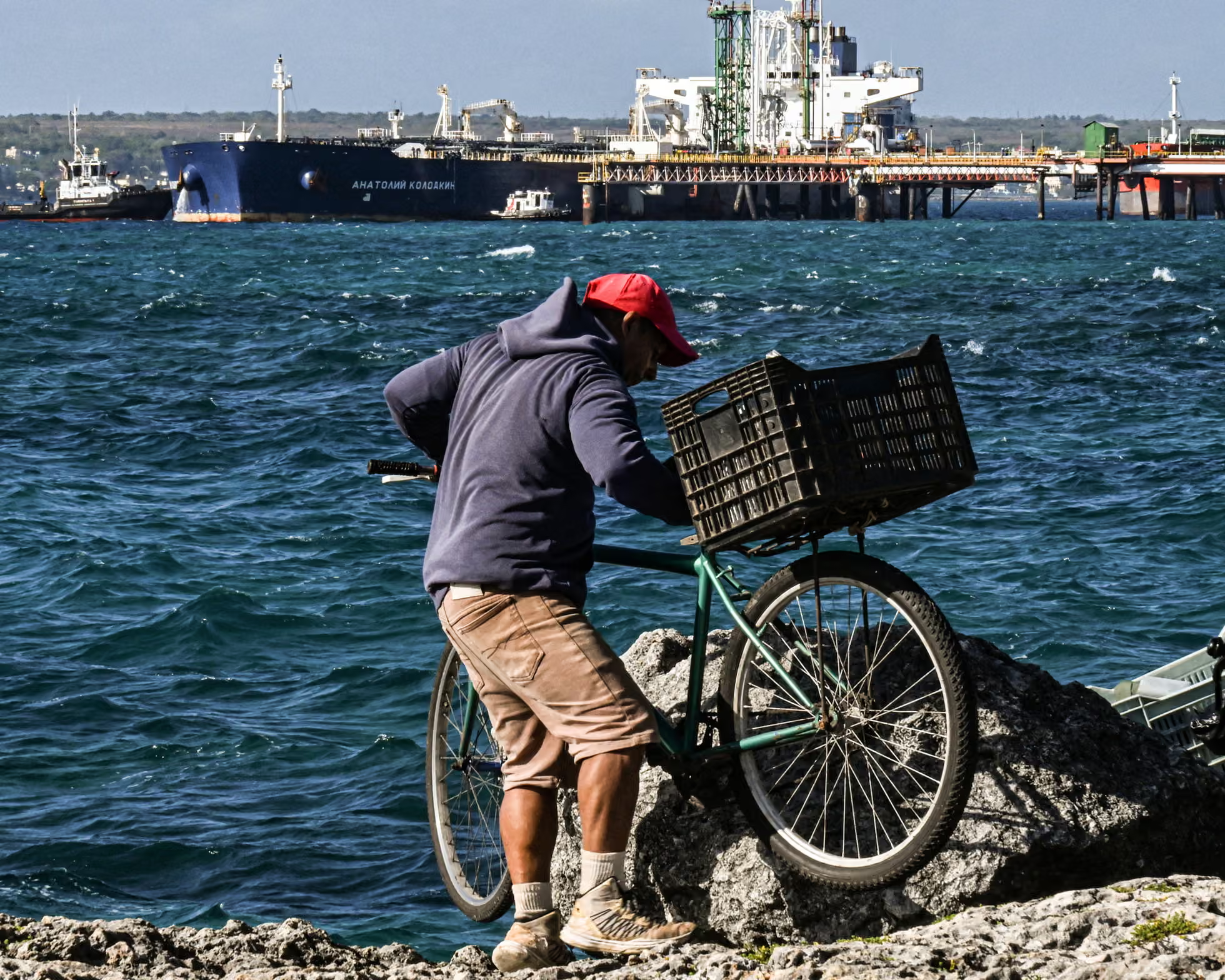
A man holds a bike as the Russian oil tanker Anatoly Kolodkin is seen at the oil terminal in the port of Matanzas, north-western Cuba, on 31 March
By Mike Treen
Since the Cuban revolution triumphed on January 1, 1959, Cuba has initiated a medical revolution as part of the social revolution. As Wikipedia noted:
The new Cuban government stated that universal healthcare would become a priority of state planning. In 1960 revolutionary and physician Che Guevara outlined his aims for the future of Cuban healthcare in an essay entitled On Revolutionary Medicine, stating: “The work that today is entrusted to the Ministry of Health and similar organizations is to provide public health services for the greatest possible number of persons, institute a program of preventive medicine, and orient the public to the performance of hygienic practices.”[15] These aims were hampered almost immediately by an exodus of almost half of Cuba’s physicians to the United States, leaving the country with only 3,000 doctors and 16 professors in the University of Havana’s medical college.
The Cuban leaders ordered new medical schools to be built to train the doctors needed to replace those who left with doctors who adhered less to the mercenary spirit of the leavers. The doctor-resident ratio increased six-fold by the late 1990s. Cuba has three times the rate of the US, UK or New Zealand – 9 per 1000 compared to 2.5 for the US and UK and 3.5 for New Zealand.
By 2012, infant mortality had dropped to 4.8 per 1,000 live births compared to 6 for the US. Life expectancy is one year less that the US (although it exceeded the US briefly during Covid). Cuba’s GDP per capita is one tenth of the US when measured in US dollars.
UK academic and Cuban expert, Helen Yaffe writes in the March 8, 2025, Jacobin entitled “Cuba Sends Doctors, the US Sends Sanctions”:
“Since 1960, some 600,000 Cuban medical professionals have provided free health care in over 180 countries. The government of Cuba has assumed the lion’s share of the cost of its medical internationalism, a huge contribution to the Global South, particularly given the impact of the US blockade and Cuba’s own development challenges. ‘Some will wonder how it is possible that a small country with few resources can carry out a task of this magnitude in fields as decisive as education and health,’ noted Fidel Castro in 2008.”
Cuba has also helped train doctors from across the globe at no cost to the tens of thousands given scholarships. Helen Yaffe writes: “In the 1960s, it began training foreigners in their own countries when suitable facilities were available, or in Cuba when they were not. By 2016, 73,848 foreign students from eighty-five countries had graduated in Cuba while that nation was running twelve medical schools overseas, mostly in Africa, where over 54,000 students were enrolled. In 1999, the Latin American School of Medicine (ELAM), the world’s largest medical school, was established in Havana. By 2019, ELAM had graduated 29,000 doctors from 105 countries (including the United States) representing 100 ethnic groups. Half were women, and 75 percent from worker or campesino families.”
There are currently 20,000 Cuban doctors working in 50 countries. The US NPR reported March 24, 2026, that the U.S. also recently passed a law allowing it to impose sanctions on countries that work with Cuban doctors.
“The countries that have broken off these contracts are afraid. They are afraid of retaliation by the United States,” says William LeoGrande, a professor of government in the School of Public Affairs at American University. “This is typical of Donald Trump’s foreign policy, which is based essentially on coercive diplomacy: ‘Do it our way, or else.’ So: ‘Get rid of the Cuban doctors, or else.’ ”
Sanctions deepened in 2019 by US President Trump
The deepening of sanctions since 2019 has resulted in the first deterioration of health statistics in Cuba ever. Even during the very difficult period in the early 1990s when the Soviet Unon collapsed and Cuba lost 90% of its trade partners and GDP declined 25%, they were able to maintain progress on health care. That is not the case today. The fuel blockade has resulted in blackouts that prevent medical institutions from functioning. Infant mortality is increasing. Life expectancy is declining.
A Science Magazine report from March 30, 2026 headed “As US blockade bites, Cuba’s health care and science suffer” is very dark and worth quoting at some length:
Cuba’s downward spiral accelerated in January, after the U.S. capture of Venezuelan President Nicolás Maduro choked off oil from Cuba’s main benefactor. (As Science went to press, the U.S. signaled it would allow a Russian tanker full of crude oil to reach Cuba this week.) The U.S. government hopes the crisis will finally dislodge the island’s Communist regime. “I do believe I will have the honor of taking Cuba,” U.S. President Donald Trump told journalists this month. Cuba’s science is collateral damage. “There’s an effort to degrade everything Cuba has achieved in education and science, and send us back to the Stone Age,” says Mitchell Valdés Sosa, director of the Cuban Neurosciences Center.
Nationwide electricity blackouts lasting 20 or more hours a day are forcing doctors to triage care and putting lives at risk. At the Hermanos Ameijeiras Hospital in Havana, “we receive the most complex neurosurgical cases in the country,” says neurosurgeon Marlon Manuel Ortiz Machín. “Surgeries must not stop; it’s sometimes a patient’s last chance.” Yet he’s been “caught in the dark” during complex operations. “All you can do is pray until the generator comes back on.”
Gail Reed, a volunteer for the U.S. nonprofit MEDICC who was in Havana last week, fears Cuba’s medical system is on the brink of collapse. “Hospitals are running out of supplies. It’s heartbreaking and unconscionable,” she says. With Cuba’s infant mortality rate rising, MEDICC is “trying to protect women with high-risk pregnancies” by installing solar panels in maternity homes, Reed says.
“We’re seeing malnourishment, people losing weight,” says Angela Garcia, executive director of Global Links, a Pittsburgh-based nonprofit. Flying into Havana last month, she says, “the first thing I noticed was an acrid odor”—from burning mounds of trash that has gone uncollected because of fuel shortages.
Damage to Cuba’s vaunted biotech sector could have an outsize impact on health and the economy. The 51 enterprises that make up BioCubaFarma, a government entity, produce scores of drugs, vaccines, and reagents, many of which are exported to 77 countries. One high-profile compound is CIMAvax-EGF, an immunotherapy against lung cancer that had positive results in early clinical trials in the U.S., done in partnership with the Roswell Park Comprehensive Cancer Center in Buffalo, New York.
During the COVID-19 pandemic, CIM teamed up with the Finlay Institute of Vaccines in Havana to produce Cuba’s Soberana vaccine, which targets the virus’ spike protein and was shown to be effective. The Cuban vaccinemakers are “among the best experts in the world,” says Fabrizio Chiodo, an immunologist at the Institute of Biomolecular Chemistry near Naples, Italy, who helped design Soberana.
The successes came in spite of long-standing sanctions that made it hard for Cuban labs to obtain equipment and supplies made in the U.S. or containing 10% or more U.S.-made components. During Trump’s first term, the U.S. tightened the screws, including by adding Cuba to the list of state sponsors of terrorism. “Some companies that were our lab suppliers for 50 years were forced to stop dealing with us,” says Vicente Verez Bencomo, head of vaccines at the Finlay Institute.
International collaborations are withering and research funds from abroad have largely evaporated. “The U.S. has managed to cut almost all sources of our revenue,” Valdés Sosa says. Major philanthropies now exclude Cuba; the Gates Foundation, for instance, has an antiterrorism policy that forbids spending in Cuba.
Airlines, no longer able to refuel on the island, have canceled many flights. “That’s how we were exporting our vaccines,” Verez Bencomo says. Some shipments continue via routes that he declined to discuss out of fear U.S. authorities would intervene. “Every time we find a way to solve a problem, after a week or two it’s blocked,” Valdés Sosa says.
Bleak as things are, key labs are maintaining a scientific pulse. Many have installed solar panels to augment backup generators and keep equipment running. To cope with fuel rationing, “we’re taking lessons learned during COVID and having people work from home,” Valdés Sosa says. Finlay bought electric bikes for staff with long commutes.
CIM, meanwhile, is continuing a phase 3 clinical trial on 400 patients in Havana for NeuroEPO plus, a recombinant human erythropoietin that has shown promise against Alzheimer’s disease. In mouse models, the drug reduced brain inflammation and neuronal death, and in a clinical trial in Cuba it improved cognitive function in people with mild-to-moderate Alzheimer’s, the team reported in 2023 in Alzheimer’s Research & Therapy. And CIM is forging ahead with a trial, launched in January, of an antibody that inhibits an immune checkpoint protein; such drugs have transformed the treatment of some cancers in developed countries—and are far too pricey for Cuba to import. “There’s huge demand from Cuban doctors to get this drug into patients as fast as we can,” León Monzón says.
Cuba’s scientists hope to preserve what they can until better times arrive. Verez Bencomo is focusing Finlay’s energies on vaccine production at the expense of research and asking colleagues abroad whether they can offer havens to some scientists to keep projects afloat. “The future of our institute,” he says, “depends on this.”
There is no doubt that these sanctions are a violation of international law. This was explained well by US commentator Mark Weisbrot in the Los Angeles Times April 2, 2026. He wrote: “The United States government is directly engaged in collective punishment of the population of Cuba, which is well documented. Collective punishment of civilians, when it takes place during armed conflict, is a violation of the Fourth Geneva Convention. It can be punishable as a war crime.”
Cuba’s role fighting the Ebola crisis
In 2014 I wrote an article on Cuba’s medical revolution and how essential Cuba’s role was to combatting the outbreak of the Ebola virus at that time. It is accessible here:
The remainder of this article is an attempt to update parts of that article that remain important and relevant today.
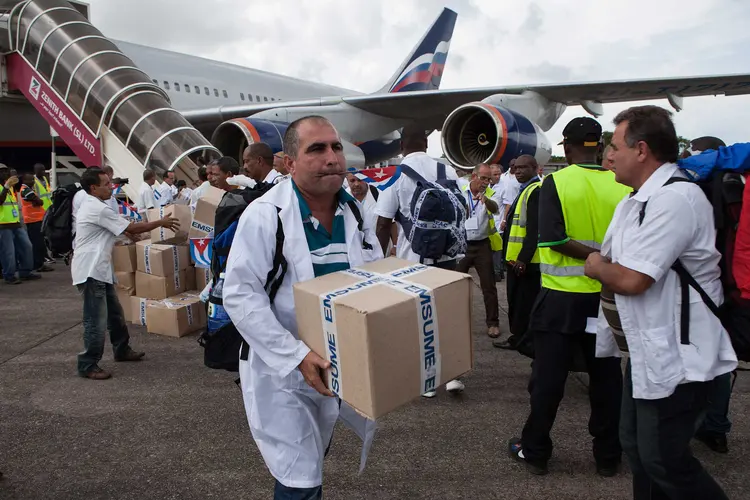
The first members of a team of 165 Cuban doctors and health workers unload boxes of medicines and medical material from a plane upon their arrival at Freetown’s airport to help the fight against Ebola in Sierra Leone, on October 2, 2014
Cuba’s single-country contribution of trained doctors and nurses sent to Africa dwarfed that of any other single country. Those sent so far are selected from 15,000 trained Cubans who had volunteered to go. Cuba has a pool of health professionals without equal in the world. The October 22, 2014, Guardian reported the ethical outlook motivating the Cubans:
Speaking before they flew to Liberia, two Cuban doctors told Reuters that competition to join the West African mission – which attracted 15,000 volunteers – had been fierce. “There have been fights breaking out, heated arguments, with some doctors asking, ‘How come my colleague gets to go and I can’t?’,” said Dr Adrian Benítez. His colleague Leonardo Fernández said the volunteers had felt compelled to help. “We know that we are fighting against something that we don’t totally understand. We know what can happen. We know we’re going to a hostile environment,” he said. “But it is our duty. That’s how we’ve been educated.”
The capitalist approach to medicine can be seen in a New York Times report on October 23, 2014, saying that the lack of a vaccine for Ebola at that time was because it wasn’t profitable to produce one:
Almost a decade ago, scientists from Canada and the United States reported that they had created a vaccine that was 100 percent effective in protecting monkeys against the Ebola virus. The results were published in a respected journal, and health officials called them exciting. The researchers said tests in people might start within two years, and a product could potentially be ready for licensing by 2010 or 2011.
It never happened. The vaccine sat on a shelf. Only in 2014 was it brought out to begin undergoing the most basic safety tests in humans — with nearly 5,000 people dead from Ebola and an epidemic raging out of control in West Africa. Its development stalled in part because Ebola is rare, and until now, outbreaks had infected only a few hundred people at a time. But experts also acknowledge that the absence of follow-up on such a promising candidate reflects a broader failure to produce medicines and vaccines for diseases that afflict poor countries. Most drug companies have resisted spending the enormous sums needed to develop products useful mostly to countries with little ability to pay.
Drug companies are willing to spend billions of dollars on treatments for wealthy people in wealthy countries but care little for poor people in poor countries. The ideal drug is in fact something that doesn’t actually cure people but prolongs a person’s life and requires repeat prescriptions. Diseases that kill tens of millions of people in poor countries get little attention.
This includes diseases like Malaria, Dengue Fever, Lassa Fever and now Ebola. The World Health Organisation estimated between 50 and 100 million people are infected with Dengue every year and 25,000 die. Lassa Fever infects 300-500,000 a year and kills 5,000.
The Cuban government made a proposal as far back as 2002 to send 4,000 doctors to Africa in a special offensive to radically expand the Aids treatment programme in that continent and save millions of lives at risk. All they asked is that the rest of the world pay for the medicines and infrastructure needed. The idea was ignored. Cuba has treated milllions of people in Africa, and millions have been saved but millions more could have been with the support of other countries. Cuban Foreign Minister Bruno Rodriguez told the UN General Assembly September 27, 2014, that Cuba already had medical cooperation agreements with 32 African countries where 4000 specialists were working before deciding to extend them to the countries most affected by Ebola. The US, in contrast, has military cooperation agreements with 49 of the 54 countries on the continent.
Cuba’s role in training doctors for Timor Leste and many Pacific Islands
Unknown to most of us in this part of the world, Cuba is also providing doctors and training locals in most of the Pacific Island states in a special medical school in Cuba, The Latin American School of Medicine. The Australian Development Policy Centre blog reported in February 2012: (https://devpolicy.org/cuba-in-the-pacific-more-than-rum-and-coke-2-20120224/):
One of the most prominent of the Cuban engagements now is in Timor-Leste where more than 300 Cuban health workers are spread around the country and which sent 700 young Timorese to study medicine in Cuba free of charge. Additionally, Cuba has worked with the government of Timor-Leste to set up a medical school in Dili initially with Cuban trainers.
Building on this regional engagement, over the past five years, the Cuban model has been extended to the countries of the Pacific through bilateral deals. In response to the dramatic shortages of the health workforce in countries such as Nauru, the Solomon Islands, Tonga and Kiribati, Cuba hosted the first Cuba-Pacific Islands ministerial meeting in 2008 where collaborations in medical education were hatched.
This put the small nations in a much stronger position than they would have been otherwise when Covid hit the world in 2019. Radio New Zealand reported on 24 September 2021:
Even where the virus has not spread, however, establishing screening, quarantine and mass vaccination programmes has stretched already limited health systems. Where community transmission has occurred, as in Fiji and Papua New Guinea, it has severely tested national health systems.
The good news is that these small nations have been more resilient than they might otherwise have been due to a dramatic increase in the number of doctors employed in the Pacific in the past decade.
In some countries this has seen a doubling or more of doctor numbers. For example, from 2012 to 2019, the number of doctors in Kiribati increased from 18 to 51. Remarkable increases have also been recorded in the Solomon Islands (79 to 170), Tonga (44 to 80), Vanuatu (27 to 67) and Tuvalu (7 to 27).
Where these doctors come from may surprise you. Most are new graduates of the Latin American School of Medicine (ELAM) in Cuba. Over the past decade, more than 250 Pacific students have travelled to Cuba, learned Spanish, and completed six years of medical training on full scholarships from the Cuban government.
Despite some problems identified in the article by Sharon McLennan, a Senior Lecturer in Development Studies at Massey University, it concludes very emphatically:
It’s safe to say, however, that many Pacific nations have been able to respond well to the challenges of Covid-19 because of Cuba’s past assistance. In particular, the strong sense of service, community and solidarity built into Cuban medical training has sustained and motivated Pacific health workers on the front lines.
The US government actively seeks to sabotage the medical aid that Cuba provides. Cuba is the only country in the world from which its residents have automatic residency rights the moment they step foot on US soil. That encourages risky and dangerous attempts to cross the sea between Cuba and the US. The US also had a special programme called the “Cuban Medical Professional Parole Program” designed to incite Cuban doctors and nurses to leave wherever they are working and go to the US with consular assistance. The New York Times estimated only 2000 were in the US under this programme until it was disbanded in 2017. It has been replaced with sanctions on countries that accept Cuban medical aid
A programme designed to take doctors from working in some of the poorest places on earth is a particularly twisted aspect of the permanent economic war waged on Cuba for over six decades. That war makes it illegal for US companies to trade with Cuba, including drugs and other medical supplies. A ship that docks in Cuba is banned from docking in the US for six months. The Cuban government estimates that the economic embargo has cost the country the equivalent of $1 trillion dollars since its inception 54 years ago.
The Liberal Party-led Howard government in Australia at the time led by John Howard (1996–2007) denounced Cuba’s medical cooperation as “destabilising” to the Pacific region, but it was ignored by the Island states. The New Zealand government has been less hostile to the presence of Cuban doctors and even assisted with English Language training before deploying in the Pacific since 2015.
But New Zealand banks cooperate with US banking restrictions on Cuba and even refuse the Cuban Ambassador here the use of a credit card. ANZ Bank was fined $6.8 million for doing perfectly legal work assisting New Zealand companies exporting to Cuba and Sudan. They paid the fine despite the illegal nature of US extraterritorial laws. During a January 2002 visit to Cuba by New Zealand’s foreign Minister Phil Goff (who I had the chance to meet in Cuba at the Museum of the Revolution while I was on a solidarity tour) the New Zealand Herald reported that New Zealand had sold $345m worth of goods the previous year, principally dairy products by Fonterra. In 2024, New Zealand exported less than $4m because of escalating sanctions which New Zealand banks and companies comply with out of fear of the consequences.
Cuba has also run a programme over the last two decades that has cured millions of people of functional blindness. It is very similar to great programme established by the late New Zealand doctor Professor Fred Hollows who was a renowned New Zealand-born eye surgeon who dedicated his life to restoring sight. A good socialist himself, he was horrified at the neglect that Aboriginal Australians in particur were forced to endure. The Fred Hollows Foundation NZ continues his legacy by fighting to end avoidable blindness in the Pacific region, training local eye care specialists, and conducting thousands of sight-restoring surgeries.
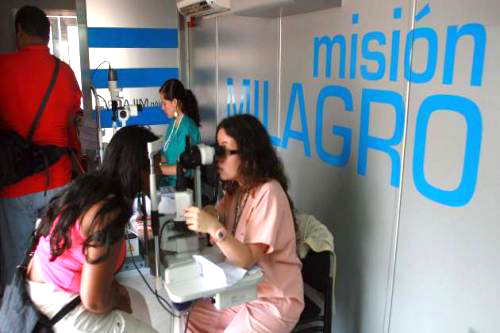
Set in motion on July 8, 2004, Operation Miracle took shape within the context of the Bolivarian Alliance for the Peoples of Our America – otherwise known as ALBA – which Cuba and Venezuela established that year also.
By 2019, over four million people in 34 countries had been cured of their ailments through a similar but far larger programme run by Cuban doctors dubbed Operation Milagro. One recipient in 2007 was a pensioned sergeant from the Bolivian Army who had captured and executed the great Argentine-born Cuban revolutionary Che Guevara in 1967.
In 2019, Cuba was itself hit by the Covid crisis and had to invent three vaccines to treat itself and achieved the same 90% effectiveness as the Western drugs they were not allowed to get. Cuba has also developed an advanced medical science with hundreds of patented drugs that we can’t access. This includes treatments for Dementia, Cancer, and Polio that would be very welcome in many of our own communities, which suffer significantly from these ailments. Diabetes is a virtual epidemic among Maori and Pacific communities with infection rates in adults up to 25% in some surveys. They have the prospect of permanent disabilities and often amputations. My own brother has dementia and look at what Cuba has achieved here. U.S. Citizens in Cuba for New Breakthrough Alzheimer’s Treatment.
In 2019, Cuba was itself hit by the Covid crisis and had to invent three vaccines to treat itself and achieved the same 90% effectiveness as the Western drugs they were not allowed to get. Cuba has also developed advanced medical sciences and hundreds of patented drugs that we can’t access. This includes treatments for Dementia, Cancer, and Polio that would be very welcome in our own communities which suffer significantly from these ailments. My own brother has dementia and look at what Cuba has achieved here. U.S. Citizens in Cuba for New Breakthrough Alzheimer’s Treatment
But the lockdowns saw a collapse in tourism to Cuba, which was their main foreign currency earner. The newly elected US President Trump also imposed new extreme sanctions, which were maintained by President Biden despite promises to remove them during the election period. When Trump returned in 2025, Cuba was subjected to a renewed and even more extreme embargo from the US empire (including fuel). This has led to very harsh conditions in Cuba and a collapse in their ability to deliver the same medical internationalism as before, including for the Pacific.
Working people worldwide need to take our own lessons from the Ebola, Covid, and similar health crises facing the world. Public health should be promoted and available to everyone on Earth. Ebola and Covid demonstrated that neglect of the Earth and its people anywhere will ultimately be a threat to human survival everywhere. Putting profits before people is a dead end, literally. The monopoly control over drugs and other aspects of medical research by the drug companies needs to be broken. Finding an alternative way of running this world which puts people and the planet before profit also must involve defending Cuba and its revolutionary example.
The world owes a giant debt to Cuba. The Nuestra America solidarity convoys are an example of what needs to be done until Cuba is free of all threats. What we can be sure of is that Cuba will not surrender despite the hardship they face. Hundreds of thousands will fight if invaded. Cuba’s most famous singer, 79-year-old Silvio Rodriguez, volunteered to fight and demanded an AK47 which was delivered by the Cuban President. This week, fuel has arrived on a Russian ship despite threats. More will come as the world increasingly wins its freedom from the US empire and its domination. That empire is declining and nations are asserting their independence as best they can. Some (like Cuba, Iran, Palestine, Lebanon, Venezuela) are fighting for their survival and we must fight side by side with them for the future of humanity and the planet. The empire’s alternative is permanent war and economic collapse. Peace with justice comes when we defeat that empire once and for all.
 GPJA
GPJA 