
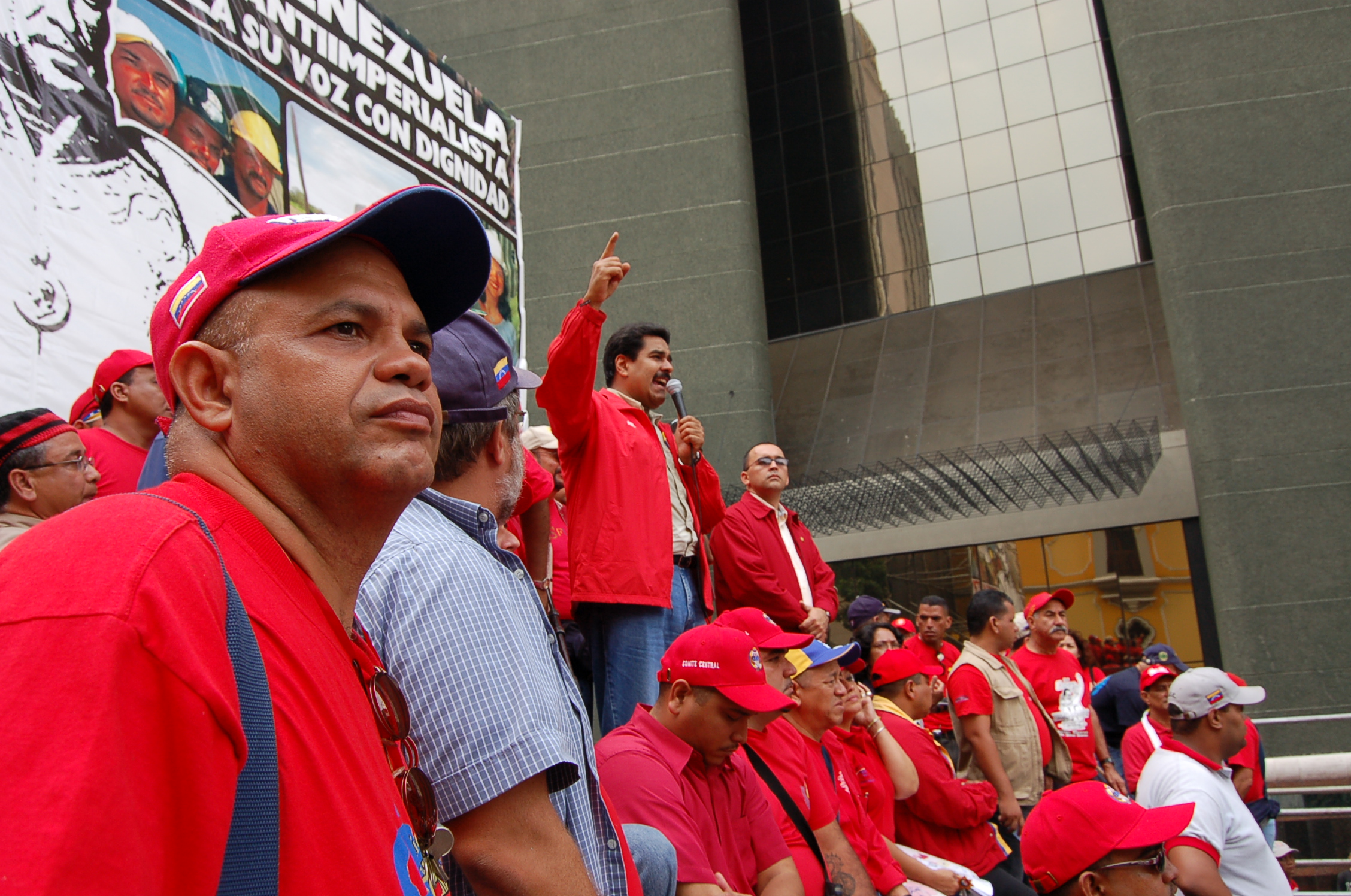
Photo by Mike Treen of Nicholas Maduro, then foreign minister of Venezuela, speaking to a May Day rally in Caracas in 2006
By Mike Treen,
GPJA Editor, Retired Unionist
May Day in Caracas, Venezuela, saw hundreds of thousands of workers pour into the streets to give their support to the revolutionary transformation of their society in the interests of ordinary people. I was there as part of an Australasian delegation of unionists representing the Unite Union in New Zealand.
The Venezuelan revolution began with the 1999 election of Hugo Chavez as President. A former military officer who had tried to lead a military rebellion against the former corrupt regime, Chavez was seen as someone who would help lead a real change in the interests of the poor. Despite immense oil wealth Venezuela is a country marked by a huge gap between the old elites who had run the country for their own enrichment as junior partners of the United States and the huge mass of the population who lived in poverty.
This divide was also overlaid with a marked racial division between a white upper class descended from European colonists and the brown and black majority who were descended from the slaves and indigenous peoples. The divide has its geographical expression in the heavily guarded upper-class suburbs and the squalid shantytowns that still every available space in the overcrowded slums of Caracas.
Since Chavez was first elected, he has faced a massive campaign to remove him that included a military coup, a bosses’ lockout that shut the oil industry for months, and a recall vote. Chávez, emerged triumphant because millions of Venezuelans had mobilized to defend their president including surrounding the Presidential Palace and military garrisons to force his release by the military officers that took him prisoner in the 2002 coup attempt.
(Today, we can watch those extraordinary events on Youtube in a film by an Irish film crew called The Revolution will not be Televised)
He has won two presidential elections with close to 60% of the vote and parties allied with him won every seat in the recent parliamentary elections. A radical new democratic constitution was drawn up and endorsed by 70% of the population in a referendum. It enshrined a broad range of democratic rights, but also guaranteed that oil would remain in the state hands, that everyone had the right to free access to health care, education, work and food. It promoted the rights of the indigenous peoples, women and children and includes protections for the environment. In December this year he faces another Presidential. Although he remains way ahead of any rival in the opinion polls he is urging supporters to get out 10 million votes to give a complete mandate for taking the revolution forward. “If you vote for me you are voting for socialism” declared Chavez in December 2005.
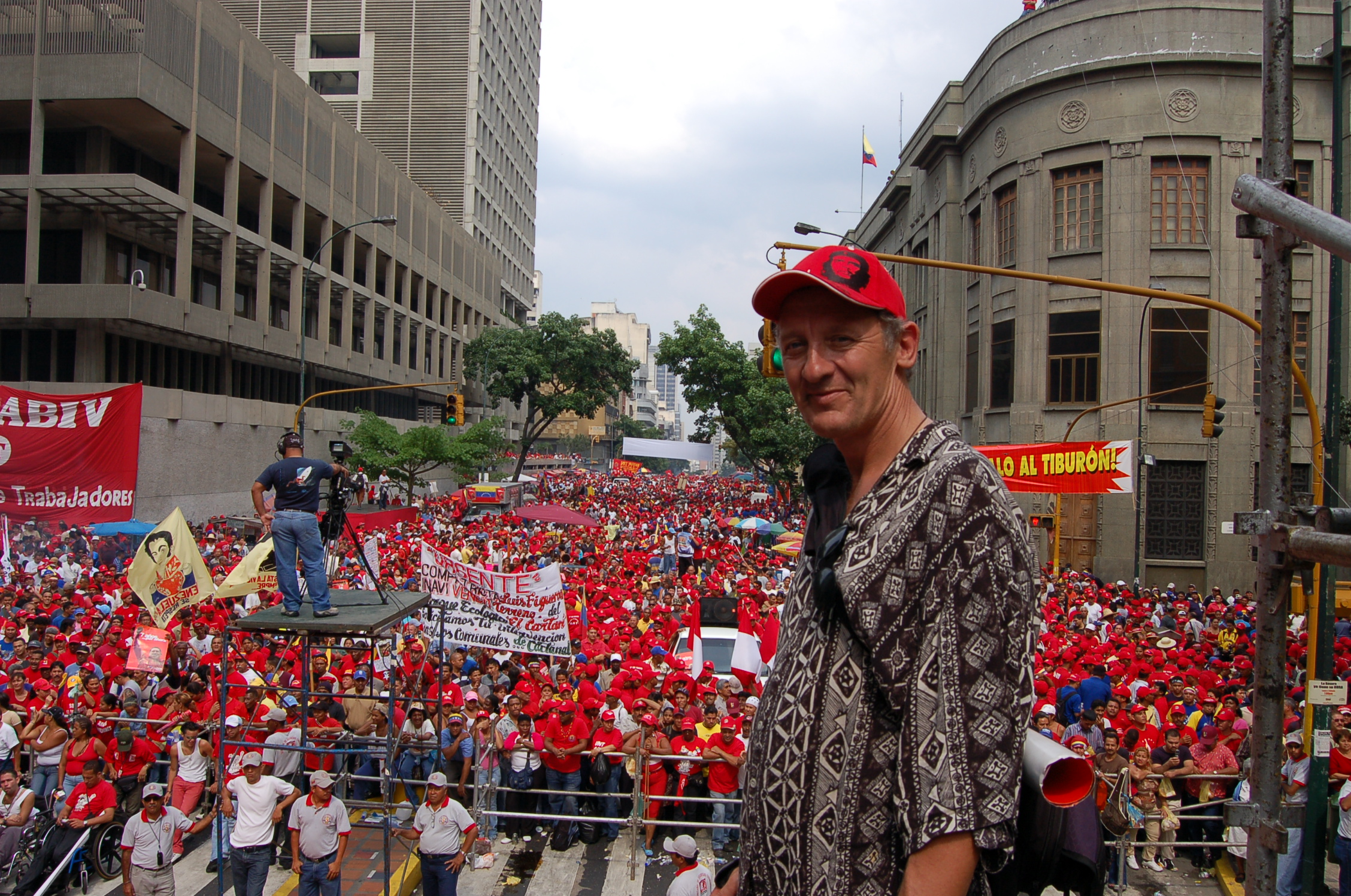
Photo by Mike Treen giving a sense of the size of the May Day Rally in Caracas in 2006
Being elected President does not make a genuine popular revolution. That requires millions of people taking part in the social and political life of the country, dismantling the old state institutions that served the ruling elite, taking economic and political power and building a new state that serves the interests of the majority. While that process is just beginning I think we can legitimately call the process underway as a revolution because it is clear that Chavez and his supporters are consciously taking the steps needed to move the process forward. Unlike many reform minded Presidents in Latin America and elsewhere who begin changes then retreat before the hostility of the US empire or the local reactionary upper classes, Chavez has met every challenge and deepened the revolution – most importantly by strengthening the role of the workers, farmers and urban poor in taking control of their lives and remaking the country to serve their needs.
We had the opportunity to see some of this close up during our two weeks in Venezuela. We visited factories being run by the workers themselves through elected councils. While affecting only a few major industries – oil, aluminium, paper and electricity – the forms of workers control being developed are pointed to as an example for others to follow. A new national union federation has been formed that is encouraging workers to make a “revolution within the revolution” by expanding workers power.
At the Venepal paper mill in Venezuela’s Carabobo state were told that it was originally occupied by the workers to stop the company plans to shut it down. After a struggle of several months it was reopened as a joint venture between the government and a workers cooperative. Announcing the takeover Hugo Chavez called on “workers’ leaders to follow this path….any factories closed or abandoned, we are going to take them over. All of them.” A part of the revenue from the plant is used to assist the local community. Rowan Jimenez, the government representative on the company’s board, told us “we are building a new socialism to improve the quality of life, reduce illiteracy, provide new sources of work and improve health. This is the socialism we believe in, this is the socialism we are fighting for.”
One of the special features of the Venezuelan revolution has bee the explosion in the number of cooperatives. They are in every area of services and production. 108,000 coops now employ 1.5 million people. But the expansion is continuing with 700,000 young people enrolled this year training courses to form coops that can contract with the state to carry out projects that meet local communities’ needs – housing, agriculture, crafts, textiles, fishing, taxis, construction, rubbish collection, plumbing and electrical work, internet and telecommunication centres. They operate under strict rules to share the income equally and make a contribution to their communities.
Because the old state couldn’t respond to the needs of the people the Chavez government has often bypassed it to carry out the social programmes needed. The current high price of oil (and higher taxes on foreign companies still operating) has given the government significantly greater income. The sacking of the state oil company management after the bosses strike in 2002 also allowed the government to get the company to meet its tax and other obligations it had been avoiding for decades.
To deliver free health care to the people the government has built thousands of clinics and hospitals throughout the country – but especially in poor urban and rural areas that had never seen a doctor. Because most Venezuelan doctors wouldn’t serve in these communities, Chavez asked Fidel Castro for help. Cuba agreed to supply 20,000 doctors and other health professionals to work there until Venezuela can train the doctors they need. Venezuela and Cuba have also launched a joint project to help train doctors and other medical personnel for the whole continent. The first priority is to eliminate functional blindness by operating on 6 million people over the next 10 years – completely free. Hundreds of thousands have been treated in hospitals in Cuba and Venezuela.
Education was also a preserve of the wealthy, with most ordinary people dropping out of school, unable to read or write. Again, with Cuban assistance, a literacy programme has been completed that taught 1.5 million people to read and write. A two-year high school programme has been started, targeting 5 million people with 800-900,000 enrolled each year. The massive oil company offices in central Caracas were taken over and the Bolivarian University of Venezuela was established with 190 satellite campuses across the country. It now has 180,000 students enrolled with a goal of 1 million in 3 years. All students receive free tuition, a student allowance and the café serves free food. A Washington Post report comments: “offices once reserved for executives who favoured free market economics are now decorated with posters of the socialist icon Che Guevara.”
The bosses’ lockout in 2002 also led the government to establish their own distribution network for food and other essentials. The prices are significantly lower and the 25,000 outlets now sell 60% of the food in the country. They also try to source products locally and encourage cooperatives to supply goods to eliminate the middleman. Special lunchrooms have been established to supply free meals for the very poor.
All these programmes involve the organization and mobilization of hundreds of thousands of people in revolutionary projects independent of the old state. Communities are deeply involved and empowered by being given control of projects that are transforming their lives.
New systems of a direct popular democracy are being developed to give effect to a genuine people’s power that is growing alongside of the institutions of representative democracy that exist. In April a new law was adopted to establish Communal Councils across the country According to the text of the law, communal councils will “represent the means through which the organised masses can take over the direct administration of policies and projects that are created in response to the needs and aspirations of the communities, in the construction of a fair and just society”. Already more than 4000 communal councils exist, with the projection for more than 15,000 to be active across all of Venezuela by the end of the year.
Based on 200 to 400 families in urban areas, or 20 in rural areas, the principal decision making body of a communal council is the citizens’ assembly. All members of the community above the age of 15 can participate in these assemblies, which have the power to elect and revoke community spokespeople to the communal council, as well as put forward projects and a development plan for the community. According to the new law, the communal councils will be funded by a new National Fund Company for a Popular Government, which has already been allocated an initial US$1 billion. According to David Velasquez, a deputy to the national parliament and president of the commission of citizens’ participation, “the communal councils are instances of constituent power that need to complement the constituted power. These new institutions will strengthen the new state apparatus that needs to emerge from the Bolivarian revolutionary process. This would imply that we need to restructure the functioning of the mayor’s offices, municipal councils and local councils. If we want to create a socialist society, we need to create a superstructure of the state that is obedient to this new reality.”
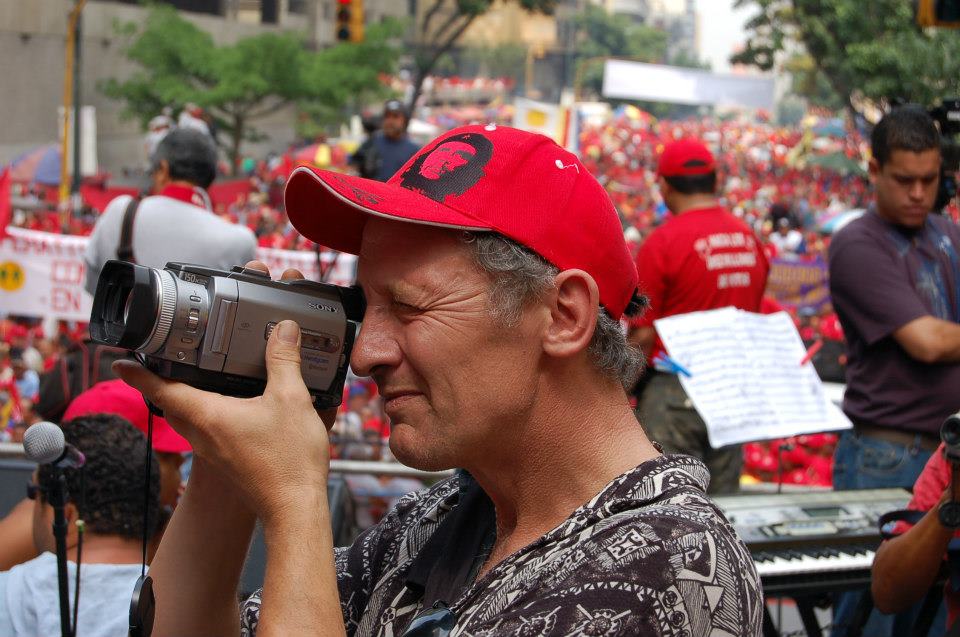
Just one more to prove I was there!
We saw an example of this new power when we visited Barrio 23 de Enero an urban jungle of dozens of large but run-down 1950s apartment blocks surrounded by makeshift housing typical of Caracas. Around 500,000 people live in this community that is within walking distance of the Presidential Palace and it was from this community above all the hundreds of thousands of people poured to surround the Palace and demand Chavez’s return after the 2002 military coup. Even by Caracas standards, it was considered an extremely dangerous place to live in or visit. Drug gangs and the corrupt police terrorized the local people. Today it stands as the equivalent of a “liberated zone” as the people have taken control, got rid of the gangsters and police and formed their own elected territorial guard to protect themselves. Since the Police were removed we were told crime has gone down by 90%. Now the big police station at the barrio edge has been turned into community centres to coordinate social programmes with their own radio station. As we walked past murals of Che Guevara and Bolivar we came across a wonderful outdoor concert and dance performance put on by the community using the talented young people living there.
Residents of this Barrio have benefited from another of the reforms which gave legal title to their properties for the first time. 10 million people (40% of the population) benefited. Land reform has been introduced to give land to farmers. With 90% of the population in urban areas the government encourages more people to farm by guaranteeing anyone 18-25 or the head of a family a parcel of land and legal title after three years (but it can only be sold back to the government).
Another unique feature of Venezuela is the fact the military is not a monolithic reactionary institution of the oligarchy. Chavez began his political struggle by organising a movement among junior officers that was opposed to the traditional repressive role of the military. Venezuela was unique in Latin America in not sending its officers for training in the US or exclusive military academies. Most went to Venezuelan universities and were affected by the deep student radicalization of the 1970s. The attempted coup in 2002 allowed Chavez to remove the most reactionary officers who showed their hand although most of the military stayed loyal to the government. The military has also been deeply involved in carrying out the social programmes and developed close links with the people.
Venezuela has forged close links with the Cuban revolution and supplies discounted oil in return for the doctors and other aid Cuba is able to provide. Since Evo Morales election as President of Bolivia in December last year he has nationalized the oil and natural gas industry and launched what he calls an “agrarian revolution”. Cuba has started supplying doctors and is assisting a literacy campaign. The three countries have joined together in a Peoples Trade Agreement for a Bolivarian Alternative for the Americas (ALBA) which promotes fair trade in opposition to US attempts to impose a “free trade” agreement on the region. It aims to unite the peoples of Latin America around “the principles of Justice and equality.” The agreement incorporates cooperation on social programmes and has launched an ambitious plan to train 200,000 doctors for Latin America and the Caribbean over the next 10 years. At the signing ceremony in Cuba on April 29 Chavez declared: “This century marks the end of US imperialism and the birth of our new great homeland, free and united, where all of us will be able to live with the utmost happiness possible.”
The US has stepped up its threats to all three countries in response. US Secretary of State Condoleezza Rice called Venezuela “a particular danger to the region” and she was “working with others to try and make certain there is a kind of united front” against Venezuela. Chavez responded “Mr Danger (US President Bush), you form your front and we will form ours.”
In his speech to the World Social Forum in January 2005, Chavez spelt out his vision of a socialist future for Venezuela and the world. “It is impossible, within the framework of the capitalist system to solve the grave problems of poverty of the majority of the world’s population. We must transcend capitalism. But we cannot resort to state capitalism, which would be the same perversion of the Soviet Union. We must reclaim socialism as a thesis, a project and a path, but a new type of socialism, a humanist one, which puts humans and not machines or the state ahead of everything.” Again in May he returned to this theme in a mass rally in Vienna, Austria: “The choice before humanity is socialism or barbarism. When Rosa Luxemburg made this statement, she was speaking of a relatively distant future. But now the situation of the world is so bad that the threat to the human race is not in the future, but now.”
He went on: “When I was a kid of 15 we had May 1968, the Beatles, John Lennon and the war in Vietnam. We looked to the future and we thought that by the year 2000, the world would be a different place, a better place. But the years have passed and instead of improving things have got much worse. What has happened? They have stolen my future. Imperialism and capitalism have stolen my future. And now that I am in my fifties, I am convinced that people of my generation must spend every day, every hour, every minute of our lives fighting for a better world – a world free from poverty, inequality and injustice. That world is called socialism! I believe that only the youth have the necessary enthusiasm, the passion, the fire, to make the revolution. Let us unite to save the world. Together we can succeed!” He concluded: “The only road, and I repeat one thousand times, is socialism. We need a revolutionary strategy and a revolutionary project must be international. Long live socialism, long live the world revolution.”
(If you have come this far, you will know why imperialism wanted to destroy the Bolivarian Revolution. The death of Chavez in 2013 and the election of Nicolas Maduro as president coincided with a collapse in oil prices, a brutal economic war on the nation of Venezuela, provoking an economic collapse in Venezuela and millions leaving the country. This post-Chávez period is best described in a recent article called “Oil wealth, class power, and imperialist siege in Venezuela” by Gary Wilson. The empire is seeking to destroy Venezuela as an independent nation. Their problem is that the army, the plebeian masses, the government, and all state institutions are united in opposition and will not surrender easily. They will be forced to make some compromise because imperialism remains a beast that needs to be placated at times but they won’t compromise the dignity of the nation.)
 GPJA
GPJA 