
By Mike Treen
The following document was first published by the recently formed Gulf Crisis Committee in March 1991. The committee was formed to mobilise opposition to the 1990 war against Iraq that the New Zealand military participated. It was written by Mike Treen and published as a supplement in the student journal Craccum with extra copies made available.
35 years later it reads well as a warning against the imperialist military adventure and that the likely consequences would be millions dead across the Middle East. This war was followed by more than a decade of sanctions on Iraq that killed millions more and were justified by the use of the “Big Lie” that Iraq possessed weapons of mass destruction. Then there was the 2003 Gulf War that killed millions more and destroyed Iraq a functioning society. The destruction of Libya and Syria as functioning independent nations soon followed.
END THE OCCUPATION AND BLOCKADE OF IRAQ (MARCH 1991)
In the final days of the war in the Gulf, tens of thousands of Iraqis – civilians as well as youth in uniform – were slaughtered unnecessarily. The US-led forces blocked all peaceful solutions and continued a merciless bombardment of troops in headlong retreat who were offering little or no resistance. The US made the cold-blooded decision that their goal of establishing a puppet regime in Baghdad could only be done on the blood and bones of the Iraqi Army and people.
By sending transport planes and a military medical team to support the US-led forces, the New Zealand Government is complicit in the bloodletting. These forces are New Zealand troops and helped provide the essential infrastructure for ground combat. They will now be supporting an occupying army.
After overwhelming and destroying the Iraqi army with unprecedented force, US President Bush declared an end to the offensive operations on February 28, 1991. A ceasefire was made conditional on Iraqi acceptance of all United Nations Security Council resolutions, including maintenance of the economic sanctions and a naval blockade. It seems clear that the US intends to fulfil the intention outlined by a Pentagon official in the February 26 Washington Post to finish the war “in possession of a large chunk of southeastern Iraq”. This area also includes most of the Iraqi oilfields. The occupation and blockade are to be used to impose the terms of surrender on Iraq.
We do not have peace in the Middle East. We have a continuation of the war through military occupation and economic blockade. This will involve a further loss of life to the Iraqi people. The sanctions imposed in August 1990, involved food and medical
supplies. This led to the deaths of several thousand civilians before the bombing campaign began on January 17, 1990. Since the destruction of the social infrastructure in Iraq, including water supply and sanitation, there has been an outbreak of contagious diseases. The February 26, 1991, NZ Herald reported: “More than 5000 women, children and elderly people have died in Iraqi hospitals since January 17 because of shortages of food and medicine, and cholera and diarrhoea are becoming epidemic in Iraq.”
Destruction in Iraq has been so massive that “experts say that rebuilding the country could cost up to $US200 billion ($NZ332 billion) and take an entire generation”, according to the February 28, 1991, NZ Herald. “Reports from Iraq indicate that nearly six weeks of Allied bombing have destroyed every single power plant, telecommunications centre and refinery in the country.”
A continuing occupation of Iraq and an economic war on the Iraqi people will add unforeseen destabilising factors to the Middle East. In this region, there are 200 million, mostly poor, Arab peoples, dispersed in 22 countries. The great majority of them are “seething with hostility to the US” explained Zbigniew Brzezinski, an official in former US President Carter’s administration, to Newsweek on August 24, 1990. In Egypt, the army has already been called out to quell student protests against their government’s role in this war. Millions have also protested throughout North Africa.
Rather than “keeping the peace”, the real aim of the occupying armies is to keep this seething mass from challenging Western political and economic domination. The uncontrollable political and social forces unleashed by this war and occupation will draw more and more peoples and countries into the arena of conflict. Their military victory in this war will have only emboldened the US rulers to launch new and more devastating wars to maintain their domination. Already President Bush is proclaiming that the “Vietnam Syndrome” – that is, mass opposition in the US to overseas military adventures – “has been kicked once and for all.”
A genuine peace in the Middle East is only possible if we begin with the defence of the Arab people’s right to self-determination.

1991 badge produced by the Gulf Crisis Committee
We must demand:
- No More Blood for Oil
- End the Occupation and Embargo of Iraq
- Withdraw All NZ, US, and Other Foreign Troops Now!
Join the Gulf Crisis Committee in a protest on Friday, March 22
Self-determination for the Arab people
ALL NZ, US, AND OTHER FOREIGN TROOPS OUT NOW!

Leader of the newly-formed New Labour Party Jim Anderton speaks to an antiwar rally in Christchurch. Credit Larry Ross.
BEHIND THE WAR AGAINST IRAQ –
REASSERTING WESTERN DOMINATION OF THE MIDEAST
HOW THE U.S. BLOCKED PEACEFUL SOLUTIONS
A week before the ground offensive was launched, Iraq accepted a peace agreement initiated by the Soviet Union that involved a ceasefire and the withdrawal of Iraqi forces from Kuwait within three weeks. Once their troops were out, Iraq wanted the UN Security Council to allow the resolutions imposing an economic blockade to lapse, as no longer necessary. Bush called the agreement “dead on arrival”. “There will not be a cessation of hostilities. There will be no pause. There will be no ceasefire. We’re going to continue to fight this war on our terms, on our timetable, until our objectives are met,” he said.
Bush then issued an ultimatum to Iraq that it withdraw within one week and accept unconditionally all UN Security Council resolutions. This included the demand for reparations, the continuation of economic sanctions and a naval embargo. The ground war was launched on February 24, 1991, in the middle of meetings of the UN Security Council called to discuss the peace plans.
On the second day of the ground offensive, Iraq ordered all its troops to withdraw unconditionally within 24 hours. Despite clear evidence this was being carried out the Allied forces continued to attack retreating troops and pressed ahead with their offensive deep inside Iraqi territory. Now the Allied forces were demanding an unconditional surrender of Iraqi forces. White House spokesperson, Marlin Fitzwater told the BBC on February 28, 1991, that the war would continue “so long as there are Iraqis left to fight”. Bush said the US would attack retreating troops “with undiminished intensity.” (NZ Herald 28/2/91).
Iraq again called for a ceasefire on February 27, 1991, saying that it would accept all UN resolutions directed at it, including renouncing the annexation of Kuwait and the payment of reparations. Again they expressed the view that this should lead to the lifting of sanctions and the embargo. The US interpreted this to mean that Iraq did not accept all the resolutions of the Security Council and vowed to continue the war. Only on the afternoon of February 28, 1991, did President Bush order an end to offensive operations.
The thousands of soldiers slaughtered in this offensive were in addition to the tens of thousands of civilian victims of the Allied bombardment. A majority of Iraq’s population is fifteen years old, or less. The bombing meant the systematic killing of children. The heaviest bombardments of Iraqi cities were launched after the Iraqi withdrawal from Kuwait. BBC journalist Jeremy Bowen, reporting from Baghdad, said on February 28, 1991, that “life gets more miserable every day” and people “wonder why the bombing continues.” The “raids appear to have a political motive”, he concluded. Over 100,000 sorties have been flown since January 17, 1991. Even if the US claims not to be targeting civilians is to be accepted, such a massive bombardment inevitably takes a huge toll. This is particularly so given that military targets included all basic infrastructure, such as communications, roads, factories, power plants, oil refineries and water reservoirs. “The people of Baghdad were convinced,” said Bowen, “that the Allied forces wanted to destroy Iraq”.
REAL INTENTION OF US TO DESTROY IRAQ
The massive war carried out by the US and its allies, together with the continuing occupation of southern Iraq, are clear signals of their real intentions – to destroy Iraq and install a puppet regime willing to follow Washington’s dictates. US President Bush’s claim in his August 10, 1990, TV address to the US people that “the mission of our troops is wholly defensive … they will not initiate hostilities”, has been exposed as a lie. Even the claim that their war aims were restricted to ending the occupation of Kuwait has been abandoned.
The Iraqi military strength appears to have been exaggerated to justify the mobilisation of Allied forces much larger than needed to simply secure the expulsion of Iraq from Kuwait. A French military expert in Arab armies Colonel Jean Louis Dufour, said it was “not convenient” for the world to know “the United States had mobilised so many nations and so much material to beat a country whose population is two-thirds of Yugoslavia and whose gross national product is a thirtieth of France.” (NZ Herald 28/2/91). Most Iraqi troops are not professional soldiers, but lightly armed militia. It was these forces that were abandoned to face the brunt of the Allied offensive.
The US aim is to re-establish complete military and economic domination by the Western powers in a part of the world that contains fifty percent of the world’s oil reserves. Forty years ago the US and Britain had stable client regimes in place throughout the region – corrupt and brutal monarchies in the main. The US had its biggest overseas airbase in Libya and other military bases in Iran. Britain had a massive naval base in Aden and fought a brutal war against the people of Yemen to hold on to it. US and British control of oil extraction, refining and distribution was complete.
Since then the region has been swept by nationalist movements that led to the overthrow of monarchies in Egypt (1953), Iraq (1958), Libya (1969) and Iran (1979). Their military bases were shut down. By the mid-1970’s oil extraction had been nationalised throughout the region and OPEC was formed. The US and Britain were forced to share a greater portion of the wealth from oil with the governments there. Today, the US and Britain aim to turn the clock back and their demands for billions of dollars from Saudi Arabia and Kuwait for war costs are the first installments.

A WAR FOR OIL
That this is a war for oil was admitted by US President Bush at the beginning of the conflict, when he said: “Our national security is at stake … and energy security is national security.” A top British adviser told Time magazine (20/8/90): “Even a dolt understands the principle. We need the oil. It’s nice to talk about standing up for freedom but Kuwait and Saudi Arabia are not exactly democracies.”
This is a war to decisively and brutally assert the West’s right to exploit the resources of the Gulf. They are defending their access to cheap oil, guaranteed by the various Arab monarchies and Sultanates. The United States has five percent of the world’s population yet consumes fifty percent of the world’s energy and natural resources. To control these resources US corporations, followed by their armies, have spread across the globe to beat down competition, whether that competition comes from Germany and Japan, or the rulers of Iraq. Four of the ten largest companies in the US are oil companies, with a staggering $US758.9 billion in combined sales. Their profits are among the highest in the world. (Los Angeles Times 14/8/90). US pre-eminence in the vital oil market is a factor behind the reluctance of Germany and Japan to get involved in the war.
NOT A WAR TO DEFEND DEMOCRACY
They say this war was to defend democracy. This will be a surprise to the people of Saudi Arabia, Turkey and Syria – US allies in the war – where to fight for democracy is a crime punishable by imprisonment or death. It will even ring hollow to the people of Kuwait, who were subject to martial law by the Emir as the first act of the “liberation”. The US, Britain and France, have armed and financed many dictators around the globe so long as they remain loyal to Western interests. This includes the genocidal rulers of El Salvador who have massacred 60,000 of their own citizens in the past decade. Even Saddam Hussein was until yesterday the West’s reliable ally in its 10-year war against Iran. This war was as predatory as the occupation of Kuwait, but in this case, Iraq received military and economic aid from Britain, France and the USA.
In Israel, the war to defend democracy includes a 24-hour curfew on the 1.75 million Palestinians in occupied Gaza and West Bank. Living under military occupation they are denied the vote and now the entire population faces collective house arrest. Not being citizens, despite 23 years under Israeli rule, they were not eligible for the gas masks issued to citizens when attacks from Iraq were feared.
The peoples of the Middle East will need to deal with their military rulers, retrograde monarchs and other privileged layers which dominate their societies. They will do this as they advance their democratic rights, national sovereignty and regain control over their wealth and resources. The US victory·will not advance this goal. In fact, these generals and emirs have been armed and kept in power to keep their people in line on behalf of the Western oil corporations.
The fact that some of these rulers have supported the US-led war, does not mean the people do. Egypt had its $US7 billion military debt owed to the US cancelled for sending troops. Opposition in Egypt is so widespread however, the regime cancelled the beginning of the soccer season for fear of crowds gathering. Over 300,000 people demonstrated in Morroco against their King’s decision to send troops. The millions of people in the area recognise the troops, tanks and planes as being a foreign occupying army not a force for democracy. They recognise the French and British insignia on the planes bombing Iraq as being from the same powers that bombed their own countries in response to previous independence struggles.
WHO REWARDS AGGRESSION
Bush says “the world must not reward aggression.” What hypocrisy! The US has done precisely that for decades with Israel, to the tune of $US4 billion a year. This is despite its 23-year occupation and annexation of Arab territory. Nato member Turkey has occupied thirty-seven percent of Cyprus since a 1974 invasion and has ignored 15 resolutions of the UN Security Council yet it remains a large-scale recipient of US military aid. The US arms the military rulers of Indonesia, despite the 1975 invasion and annexation of East Timor which has resulted in hundreds of thousands of deaths.
The United States also has no right to claim to defend international “law and order”, when it has systematically violated these principles for decades. In the last 40 years the US has invaded Lebanon (1958), the Dominican Republic (1965), Grenada (1983), Panama (1989); fought wars in Korea and Vietnam; sponsored proxy invasions of Cuba (1961) and Nicaragua (1979-90). The US ignored UN resolutions such as those condemning the invasion of Panama and refused to recognise the authority of the World Court, the principal judicial body of the UN, which called for a halt to US attacks on Nicaragua.
LEGACY OF COLONIALISM
The current conflict in the Middle East is a reflection of the brutal legacy of colonialism. The states in the region were established with borders drawn, and rulers selected, by the colonial powers. The oil mini-states of the Persian Gulf – Kuwait, United Arab Emirates, Qatar, Bahrain, – were established as staging posts of the British Empire. Their strategic importance as bases for the Empire’s naval dominance was increased in the twentieth century by the discovery of “Black Gold”. States were established, with borders matching the oil concessions granted to British and other oil companies. This had the advantage of separating the wealth of the region from the population and making the rulers dependent on foreign protection.
At independence, in 1961, Kuwait had a population of 300,000, the United Arab Emirates 180,000 in 1971, and Qatar even less the same year. Even the populations were largely immigrants excluded from the profits reserved for “natives”. Based on historical links that go back to the Ottoman Empire and its Basra province before World War One, Iraqis have long claimed Kuwait was part of their country. When London declared Kuwait an independent emirate in 1961, the Iraqi government asserted a claim to it. “You have made a state out of an oil well” Iraq’s then ruler General Kassem told Britain. British troops were sent to prevent an Iraqi takeover. Border disputes flared again in 1967 and 1973.
IMMEDIATE BACKGROUND TO IRAQI OCCUPATION
The immediate background to the invasion of Kuwait by Iraq centred on a dispute over oil. In July 1990, Iraqi President Saddam Hussein accused Kuwait and the United Arab Emirates of flooding the international oil market and driving down prices at the behest of the United States. This cost Iraq $US14 billion in lost revenue. He also accused Kuwait of stealing $US2.4 billion in Iraqi oil from wells in the Rumaila oil field along the disputed boundary between the two countries. Earlier, Kuwait rejected Iraqi claims to the islands of Bubiyan and Warbah at the head of the Gulf. Control of these islands would have given Iraq access to the sea which it lacks because of the way Britain drew up the boundaries in the 1920’s.
Iraq was also led to believe that the US would not oppose its takeover since political relations had improved so dramatically since the invasion of Iran. In July 1990 the US ambassador to Iraq, April Glaspie, met Hussein and explained: “We have no opinion on the Arab-Arab conflicts like your border disagreement with Kuwait. .. lf we are unable to find a solution, then it will be natural that Iraq will not accept death.” Not only did the US not issue any warnings when Iraq massed troops on the Kuwaiti border, but the US State Department issued two statements in the week before the invasion, saying the US had no obligation to come to Kuwait’s defence. Five days before Iraq’s invasion, the current US commander of the Gulf forces, General Schwarzkopf, ran a command exercise for 350 staff officers. It was based on a Middle Eastern nation invading a neighbour and threatening US interests!
BEHIND THE FIG-LEAF OF THE UNITED NATIONS
The US has made great play of the fact that their military adventure in the Gulf is supported by the United Nations. It is true that the UN Security Council authorised the use of force to evict Iraq from Kuwait. However, no UN military command was established. All foreign forces in the Gulf are under US operational command. Nor was any vote taken in the UN General Assembly with its 160 member states. The Security Council has only 15 members – five permanent members plus 10 appointed by the remaining members for two-year terms.
It so happens that all five permanent members have veto power over any resolution brought before this body. This veto power makes one country’s decision-making ability equal to that of all the remaining UN members. When the veto was established under the UN Charter in May 1945, someone commented: “The matter is quite simple. Any difference among the smaller nations is settled by the big nations. Any difference between a big nation and a small nation is settled by the big nation. But if there is a difference among the big nations, the organisation ceases to exist.”
The permanent members are the victorious powers in World War Two – the US, France, Soviet Union, Britain and China. (Until 1971, China’s seat was held by Taiwan). Britain with a population of 60 million has a permanent seat, but India with 800 million does not. It’s hardly a democratic body.
The United States routinely ignores resolutions of the General Assembly and vetoes resolutions of the Security Council when it is in a minority. In the seven years 1983-89, the US voted in favour of only 136 of the 1064 resolutions approved by the General Assembly – thirteen percent of the total. The US did not vote in favour of a single one of the 59 resolutions on South Africa, not one of the resolutions against South African occupation of Nambia, only 10 of the 97 resolutions on the Palestinians, only 3 of the 85 on decolonisation and 3 out of 46 on human rights. In the Security Council, on the other hand, the US approved eighty percent of the 131 resolutions.
From January 1983 until August 1990, 35 resolutions were vetoed in the Security Council – 33 by the US. Some examples were:
- In 1983 the US vetoed a resolution condemning the invasion of Grenada.
- In 1986 it vetoed a resolution condemning the US attack on Libya.
- In 1987 it vetoed a resolution for Namibian independence.
- In 1989 it vetoed a resolution condemning the invasion of Panama.
ECONOMIC DEVASTATION
The military and human devastation of this war will bring economic destruction in its wake to millions of people, especially in the Third World. Oil companies have taken advantage of the war to sharply increase prices. The February 16, 1991, NZ Herald reported: “The major United States oil companies earned $US4.2 billion ($NZ7 billion) in net profits in the fourth quarter of 1990 a 147 percent increase from the $US1.7 billion a year earlier”. In New Zealand, petrol prices remain 10c a litre higher than at the start of the crisis, despite crude oil prices declining below the level existing then.
The people of the non-oil-producing Third World, who are dependent on oil-based products for power, heating and cooking will be especially hard hit by the price rises. Their already indebted nations will fall further behind in payments and have new rounds of austerity imposed on them by the World Bank and International Monetary Fund. The primary beneficiaries of the war will be the banks, oil companies, arms merchants and their owners. The leap upwards in the world share markets with each Allied victory, reflected this fact.
The primary victims will be working people on both sides of the conflict, who will pay the price in deaths, mangled bodies, economic devastation and shattered lives. The war will be used by our rulers to place the blame for the deepening international recession on Iraq and to justify maintaining inflated military budgets while cutting back on social spending.

The “Highway of Death” leading from Kuwait to Baghdad
AN ENVIRONMENTAL DISASTER
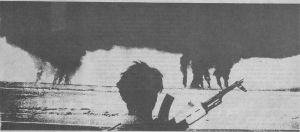
The consequences of the war are the greatest environmental threat the world now faces. Already we have seen the largest and potentially most damaging oil spill the world has ever known. It will be the start of a catalogue of environmental disasters. Fires in the Kuwaiti oil wells alone could burn approximately 3 million barrels of oil a day, creating enormous smoke clouds and possibly altering global weather patterns. The bombing of Iraq’s nuclear research and chemical plants has had unknown consequences.
Both sides reserved the right to use “all means” at their disposal in this war. There is no evidence that Iraq used chemical weapons. The United States has, however, used both napalm and fuel air bombs.
Napalm is a petroleum jelly extensively used during the Vietnam War. In Vietnam, it was refined to improve its adhesion to skin tissue and to keep burning even if submerged in water. The fuel-air explosives or FAEs, are known as the “poor man’s atom bomb”. FAEs carry a fuel such as petroleum which is sprayed into the air over a target, spreading a cloud of gas. When the gas is ignited, the explosion sucks oxygen out of the atmosphere, including the lungs of people inside blastproof tanks and bunkers.
There is no evidence that Iraq has, or was close to, developing nuclear weapons. This propaganda ploy was prompted when opinion polls in the US showed that preventing Iraq from having these weapons was a popular justification for the war. The US had hundreds of nuclear warheads on its warships in the Gulf. General Schwarzkopf, the US military commander in the Gulf, requested the use of a warhead to knock out Iraqi communications.
DEMOCRATIC RIGHTS UNDER THREAT
War reinforces every anti-democratic trend in society. It has been used to impose censorship over the media. The British Broadcasting Corporation has even banned songs like “Imagine” and “Give Peace a Chance” by John Lennon. Refugees in particular have been targetted. In New Zealand, 30 refugees have been detained without charge for weeks. The government has begun to send them back to the countries they fled from, without the right to a hearing. The UN Convention on Refugees clearly says that no contracting state will expel or return a refugee to the frontiers of territories where their “life or freedom would be threatened on account of his race, religion, nationality or membership of a particular social group or political opinion.”
If the refugee is considered a “threat to security or public order” they are still to be given the right to submit evidence to clear him or herself of suspicion and appeal against adverse decisions. This is being denied to refugees in New Zealand. Racist thugs have also been emboldened by the anti-Arab, anti-Muslim propaganda, to feel they can take action themselves with impunity.
CENSORSHIP – THE SANITISED WAR
The Allied military imposed censorship of war news from the Gulf, and the self-censorship of the mass media, have together presented a sanitised, pro-war version of the conflict. Much of this has been concealed from the public. For instance, only the very first report from the Gulf by NZ Herald reporter Tim Donoghue, carried a note at the end, “cleared by New Zealand military censors”. An important and relevant fact not repeated in subsequent stories.
Allied command press briefings have been presented as “news”. No independent verification of any assertions made is provided. The US military has never retreated from a single one of their claims despite overwhelming evidence to the contrary. They continue to insist that the bombed baby food factory was a biological warfare facility and the destroyed Baghdad bunker, was a military command centre.
Claims, assertions and lies -“disinformation” as it is called -have been cranked out to suit the war aims of the allied forces. Claims that the Iraqi forces were torching oilfields and executing civilians in Kuwait were conveniently released just in time for US President Bush to use this “news” to justify launching the ground war. Press reports that are not controlled by the allied military, such as those by Cable News Network (CNN) reporter Peter Arnett, have come under fire as Iraqi propaganda.
Press restrictions included:
- requiring that all copy and film be submitted to security reviews;
- limiting news coverage to assigned “pools” of reporters;
- not allowing reporters to live with military units, instead rotating them in and out with military escorts.
Only 150 of the almost 1500 reporters in the region are assigned within pools. The military decides where they go and provides transportation and an escort. For the rest “it means spending all day and night in a palatial hotel,” reports the February 22, 1991, NZ Herald. “Many British and American reporters have been in Riyadh (Saudi Arabia) without once leaving the city.” Some reporters, including from the New York Times and Time magazine who have tried to get information from outside the pools, have been detained, interrogated and had their press credentials revoked.

When asked how the pool system was working, Stanely Cloud, Time magazine’s Washington bureau chief, said it is “like asking if a smoothly functioning dictatorship is working well. Yeah, it’s working well but we shouldn’t have to put up with it. We’re only getting the information the Pentagon wants us to get.”
The press has also been complicit in the propaganda ploy of dehumanising and demolishing the enemy. We have had constant reports of “Saddam’s missiles”, and “Saddam’s army”, and that the goal is to destroy ”the madman Saddam”. Iraq, its people, history and culture have been obliterated in our consciousness, just as completely as they have been destroyed under Allied bombardment.
Even when film has been available of the human cost of war to the Iraqi people, it has not been shown. CNN used parts of a report that showed 172 homes destroyed in one bombing raid but cut the scenes of bodies of dead children being pulled from them. None of the Western TV showed the film of the pieces of the still smouldering bodies of women and children being carried out of the Baghdad shelter hit February 13, 1991. Dehumanisation is also reflected in the special language developed by the military. Civilian casualties become “collateral damage”. Iraqi soldiers killed are “assets taken out”. Even US soldier deaths are called “KIA’s”, that is, killed in action.
EXAMPLE ONE – THE BABY FOOD FACTORY
On January 23, 1991, CNN journalist Peter Arnett, reported Iraqi claims that the US had bombed a baby food factory and showed film of the rubble, twisted girders, stainless steel tanks and piping. The factory “looked innocent enough from what I could see,” Arnett reported. CNN added some archive footage of the factory when it had been operating. It included a shot of a worker in white overalls clearly labelled “Baby Food Factory.”
The response was immediate. White House spokesperson Marlin Fitzwater claimed it was a biological warfare plant, and that Arnett’s report was a classic example of Iraqi disinformation. “We had information on this for a long time and cannot share it with you for security reasons,” said Fitzwater.
A British cabinet minister called Arnett a latter-day Lord Haw Haw. (A British broadcaster for Nazi Germany). New Zealand Prime Minister Jim Bolger was darkly suspicious about the overalls being labelled in English.
But what the US propagandists had not reckoned with was that the NZ Dairy Board has been providing dairy technology to Iraq for 20 years, and has fat contracts for supplying milk powder to Iraq. Dairy Board personnel recognised the wrecked factory shown on TV as being quite definitely a baby food factory. “New Zealand technicians Malcolm Seamark and Kevin Lowe who worked in Baghdad in 1990 building a cheese factory near the bombed out plant, said the factory produced powdered milk,” reported the February 10 Dominion Sunday Times. Seamark told TV news he recognised the man in the baby food overalls – “Big Mac”, as he was known.
Then, to make things worse for the US disinformation effort, Taranaki dairy engineer Kevin Lowe confirmed to newspapers that he had been in the same factory last year and that it was quite definitely a baby food factory.
We understand that Jim Bolger’s office put “strong pressure” on the Dairy Board to smother the people who knew something about the plant. And after the horse had bolted, Broadcasting Minister Williamson put out his stern warning to the media “not to buy into Iraqi disinformation”.
To put the final nail in the coffin, the New Zealand ambassador to Iraq turned up and said he could not imagine the equipment in the plant being used to manufacture biological weapons and he had no complaint with the way Arnett had reported it.
EXAMPLE TWO – THE BAGHDAD BUNKER
Hundreds of civilians were incinerated in a Baghdad bunker on February 13, 1991, after being hit by two laser-guided bombs. The US military and government spokespeople insisted it was a military command centre and that Saddam Hussein had put civilians there deliberately to be killed. As usual, no evidence was used to back up this claim.
The February 15, 1991, NZ Herald dutifully chimed in with an editorial referring to “human sandbags”. Prime Minister Bolger commented that in war “civilian casualties were inevitable.”
US claims that the bunker was camouflaged and surrounded by barbed wire were denied by reporters at the scene. “Well they’ve got bad eyes” replied Lt. General Thomas Kelly, director of operations for the US Joint Chiefs of Staff, when this was pointed out to him. BBC reporter Alan Little said that the bombed building was in a small compound that included a school, supermarket and mosque. “I saw no evidence of nearby military installations”, he reported. The manager of the shelter told journalists: “We didn’t have a military man in the shelter. .. .it is allocated to civilians.” The local residents said that thousands of people had been using the shelter each day since the bombing began three weeks earlier.
The February 15, 1991, NZ Herald reported that Lt. General Kelly had said that the US had evidence (not released) that military personnel had entered the bunker in the preceeding days. “He said that the United States had no evidence that civilians had entered the building before the night attack but conceded, they might have gone in after dark.”
The process of categorical denial continued. The February 16, 1991, NZ Herald reported Lt. General Kelly once more: “The reporters who scoured the rubble unable to find any military equipment, were ‘being duped’. The residents who said the building was being used as a bomb shelter for several nights were speaking to a ‘controlled press’, General Kelly said, although Iraqi officials allowed the first reports of the damage to be broadcast without prior review. General Kelly also said it was ‘strange’ that the cameras showed a bomb shelter with signs that had been written in English. When one reporter who had recently returned from Iraq noted that many signs in Baghdad were written in Arabic and English and that identical bomb shelter signs could be seen all over the city, the General said he did not know that.”
Three days before the bombs hit the bunker Defence Secretary Richard Cheney and General Powell, Chairman of the Joint Chiefs of Staff, signed their names to two 2000-pound laser-guided bombs known as GBU-27 – the exact type dropped on the bunker by a Stealth bomber. The New York Times reported that Cheney flashed a “wicked smile” as penned his message “To Saddam, with appreciation, Dick Cheney.”
DEMOCRACY – KUWAITI AND SAUDI KIND
In Kuwait, two-thirds of the population of two million are denied citizenship rights and the monarchy monopolises the country’s wealth in its own hands. Kuwait’s parliament, elected by only three percent of the population – male citizens with certain property – was abolished by the Emir in 1985. When protests demanded its recall in 1990, the Emir had the protest organisers arrested. The exiled government has recently ruled out new elections if it is returned to power.
Saudi Arabia is one of the most brutal and reactionary regimes in the world. Recent law changes allow the use of front-end loaders to stone people to death. Women are not allowed to drive cars. There are no elections. Government is by royal decree and the ruling family monopolises the oil wealth.
The majority of the population in Kuwait and Saudi Arabia are immigrant workers denied all rights, even if their families may have lived there for several generations. One million Yemeni workers were expelled from Saudi Arabia when the Yemen government opposed the US military intervention. In Kuwait, “foreigners” cannot own property, are denied medical care provided to citizens, are barred from participating in politics and are not allowed to join trade unions. 150,000 domestic workers from Asia are treated as virtual slaves. A New Zealand teacher, Dianna Seavill, described their lives in the September 9, 1990, NZ Herald. “Domestic workers were held as virtual prisoners … get no days off, have their passports taken off them and go months without pay. We read occasional horror stories in the daily newspaper about the Indian maid who had been beaten, starved, locked up or even set on fire by her employer who subsequently got off with a 30 pound fine or a short suspended sentence.”
Kuwait’s worldwide assets are estimated at $US100 billion, earning $US10 billion annually for its rulers, as much as the annual oil income. Virtually the entire amount is invested in Europe, Japan and the US in government bonds and major corporations, like British Petroleum, General Electric and Toshiba. The benefits of this vast wealth are controlled by the 2000 idle princes of the El-Sabah royal family. It is certain that these sheikhs, princes and emirs, did not venture out of their palaces and foreign apartments to join the troops on the front lines who were being asked to lay down their lives to defend their anachronistic regimes. The September 8, 1990, Washington Post reported that Sheik Jabir Ahmed Sabah “is conducting business out of an opulent fifth-floor suite in the mountain resort of Taif, Saudi Arabia, where he fled after the August 2 Iraqi invasion.” It was from this apartment he ordered martial law imposed on “liberated” Kuwait.

Protests against the war in the United States, January 1991.
 GPJA
GPJA 