
By Mike Treen,
Retired Union Advocate
I want to celebrate the recent decision by McDonald’s to begin repaying tens of thousands of current and previous employees for what I characterised as “wage theft” when I was the union representative dealing with that company.
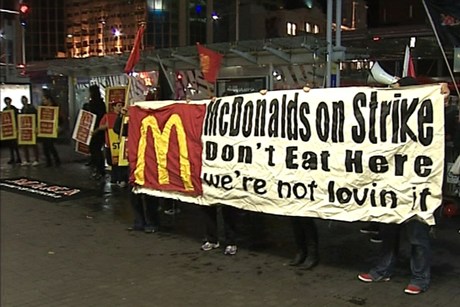
On its website this week, the company said it had been approved by the Ministry of Business, Innovation and Employment (MBIE) to begin remediation.
McDonald’s is contacting those employed between November 1, 2009, and December 6, 2020, asking them to check a portal on its website to see if they’re eligible for reimbursement.
They are still trying to chisel their workers by tricking them into agreeing to have what they call “overpayments” deducted from “underpayments” before the payment is made. Workers are not legally obliged to agree to do that. They can simply email the company to say they don’t agree to that happening. If they don’t agree, the alleged “overpayment” can’t be deducted.
It had become clear to us in 2015 that nearly every major employer was non-compliant and probably owed their staff money.
Documents released in 2016 by the agency responsible for Holidays Act enforcement MBIE estimated that a third of New Zealand workers were being underpaid by at least $500 a year. That would be worth 3-4 billion dollars.
It later came to light that MBIE had known about widespread non-compliance since 2012 but had been instructed to sit on it by the 2008-2017 National government at the time.
On 9 December 2014, MBIE told the government that “most employers have made little attempt to comply” with their obligations to pay workers correctly under the Holidays Act.”
The documents show how MBIE initiated discussions where “payroll providers and large employers provided frank feedback on the issues that lead to non-compliance” and these groups were acknowledged for how they “generously gave their time and insights.”
Officials commented that: “The Labour Inspectorate has significant intelligence as to the size and location of many of these breaches. However, it has decided to concentrate on reactive work regarding the Holidays Act while the Ministry gets a handle on these issues.”
I wrote to all the employers Unite Union dealt with at the beginning of 2015. They all simply went into denial, We then sought wage and time records to prove our case and prepared to take legal action against McDonald’s at the end of 2015.
After we had taken that legal action MBIE publicly acknowledged for the first time in March 2016, that it was a widespread problem and set up a working group to work on the problem.
On April 1, 2016, the Daily Blog had an exclusive by me detailing the systematic wage theft under the headline “EXCLUSIVE: Holiday pay miscalculation more than a “mistake. I wrote:
It seems that the problem is so massive that only a government-led process can ensure all workers in New Zealand are being paid properly.
The government should convene a working party involving unions, employers, and payroll providers to devise solutions that can be imposed on all employers.
No employer should be allowed to claim it is all too complicated. That is a lie.
There has been large-scale theft. It appears to be deliberate. Workers must be paid their full entitlement going back as many years as is necessary.
Unfortunately, the government left MBIE in charge of the process and they have allowed many private-sector employers to escape responsibility.
State sector and local body employees have all had a remediation process. The public hospitals alone are having to repay an estimated $2 billion to employees.
Instead of forcing the major payroll providers to do something collectively to fix the problem in the private sector, MBIE announced a list of what they determined were the 100 major private sector employers to audit. Their list didn’t include Armourguard, First Security, or Burger King which should have been included.
Some employers went back to 2003 to calculate what they owed, but most went the minimum they considered they were legally obliged to – usually six years.
Because each investigation has been an almost forensic examination, MBIE has refused to add any more companies to its existing list. Most private-sector employees won’t get anything. Usually, it is only companies with an active union presence that have ensured compliance if they were not on the original list of 100.
However, many employers have been forced to repay billions of dollars in stolen entitlements. This is worth celebrating.
 GPJA
GPJA 