
By Mike Treen, retired union advocate.
In May 1990, a month-long strike occurred at Ford and Mazda owned Vehicle Assembly NZ (VANZ) plant in Manukau City. I was working at the plant at the time and became an active participant in the delegates group. A record of that dispute was prepared by me following the strike. I published it as a booklet at the time with copies of the media coverage and company letters and a few thoughts on the lessons we could learn from the dispute.
The booklet is attached. The booklet text follows below to make for easier reading.
The dispute involved workers at the assembly plant which had around 500 workers was one of three operations owned by Ford and Mazda at Manukau. The other sites were an Allow Wheel Plant and the Sylvia Park Distribution Centre which are mentioned in the narrative.
Subsequently, I was dismissed from the plant after the company hired a detective agency called SIS Ltd to investigate my background. The official reason for the dismissal was not revealing to them that I had a university degree. But that is another story.

A RECORD OF THE VANZ REDUNDANCY FIGHT
Thursday, May 3
A joint meeting of Engineers, Electricians and Cleaners at the VANZ Wiri site voted overwhelmingly to reject a proposed redundancy agreement. Because the scale (8 and two) was considered too low and the mandatory transport clause was unacceptable.
When approached by union officials and delegates, the company refused to consider changing its stance on either issue. The meeting then votes to strike and establish a 24 hour picket. Caravans are hired by the Union (without their knowledge initially) for the front and back gates.
The company sends out its first letter. This strike is called “irresponsible” as the letter asserts the redundancy agreement “recommended by your union officials is competitive.”
Friday May 4
New Zealand Herald reports Engineers Union organizer Peter Devlin saying he had recommended acceptance. “Unfortunately it was rejected – it is unfortunate, but that’s democracy,” he said. Ford spokesman Russell Scouler is quoted as saying “the company did not intend changing an offer that had already won favor from officials of the union concerned.”
Monday May 7
Devlin held meetings at the Alloy Wheel Plant where he urged acceptance of the agreement. Two shifts voted in favor and one against. This action helped undermine the stand of the VANZ workers.
A second letter is sent by the company highlighting the acceptance at the Alloy Wheel Plant and repeating that it “will not be making any further offers.”
Thursday May 10
Union meeting held to assess progress. Workers have to walk past an intimidating line of about 30 company personnel to get to the meeting. Officials from three unions in attendance to urge acceptance of the redundancy deal. These include Peter Denny, Assistant Secretary of the Engineers Union; Selwyn Clark, secretary of the Cleaners Union; John Churchill secretary of the Electrical Workers Union. Denny refuses to allow Albert Vahaakola (the Engineers Union chief Delegate on the site) the right to chair the meeting. All three officials give lengthy speeches urging acceptance of the deal. But the workers vote against the deal in a secret ballot by 308 to 118. The Cleaners and Electricians secretary then pull their members out of the meeting where they have separate votes to return to work. The secretaries return to the Engineers meeting to urge that they also abandon the strike, as did Peter Denny again. Despite these appeals the Engineers vote 182 to 152 by secret ballot to continue the strike “indefinitely”.
During the workers made their anger at the officials lack of support during the strike and their disgust at the public attacks on the workers stand. They were repeatedly asked who they worked for – the company or the workers.
Friday May 11
The workers decision to continue the strike is again publicly criticised in the New Zealand Herald which reports that Peter Denny ‘confirmed that he had asked the workers to abandon the strike”. On the mandatory relocation clause “Mr Denny said the union’s position was that it was better for its members to have jobs than be made redundant.”
A third letter is sent by the company urging acceptance.
Monday May 14
At the delegate’s request, Jim Butterworth (Engineers Union District Secretary) meets the strike committee members in the caravan. Concern is expressed to him that the workers were feeling abandoned by the union.
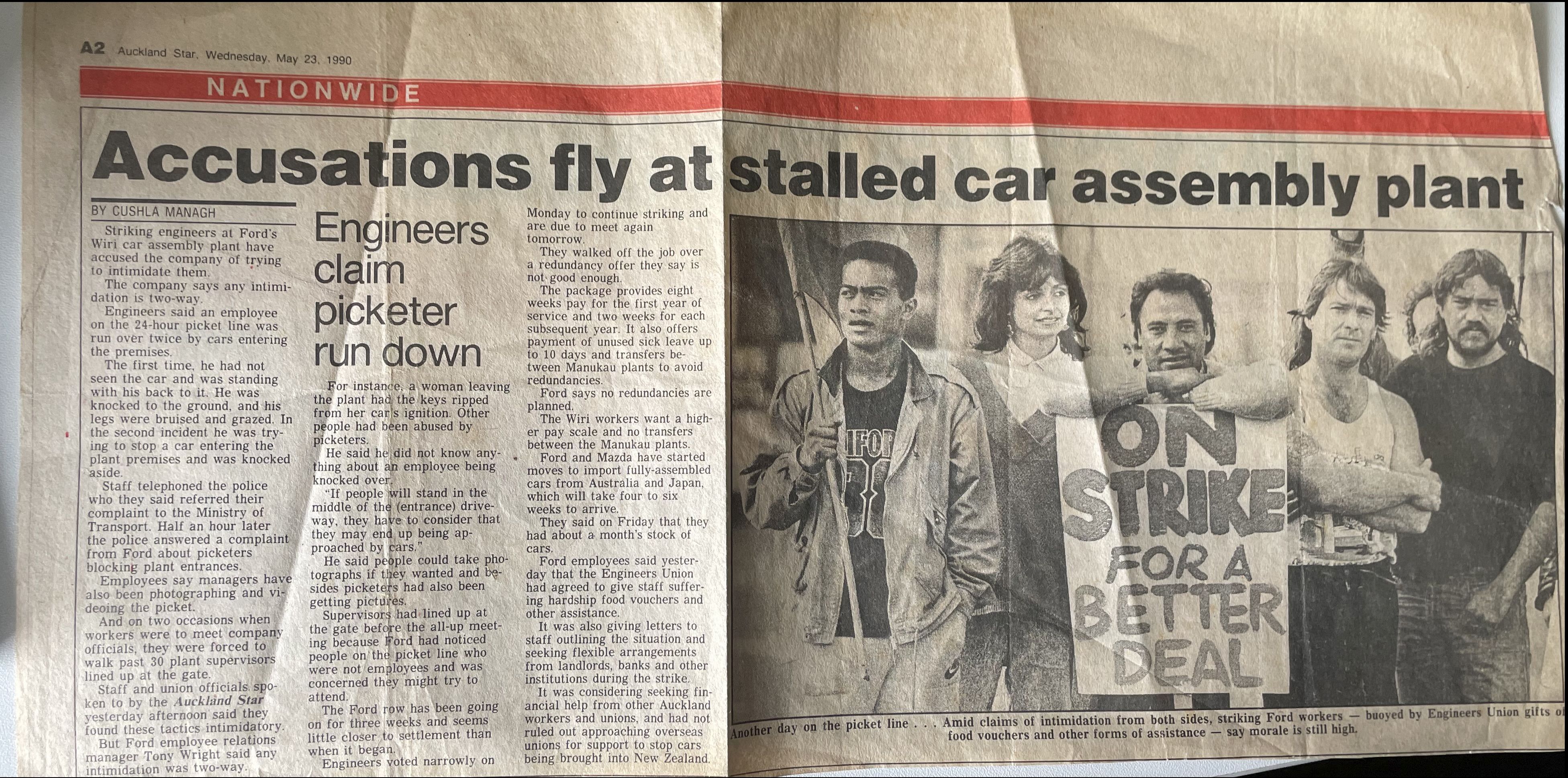
Tuesday May 15
A union meeting is held in the car park when the company refuses to remove intimidating lineup of personnel at the gate. Jim Butterworth attends this meeting and explains that while he considers the 8&2 acceptable he isn’t happy with the mandatory transfer clause. Next meeting called for Thursday May 24.
Maintenance fitters meet separately. Many are unhappy with the strike and want to return to work but are told they are bound by the democratic majority vote of all Engineers Union members.
Thursday May 17
Following a meeting of all unions affected by the strike called by the Northern Distribution Union secretary Mike Jackson, a proposal is put to the company that was seen as providing a basis for a return to work while giving the workers some guarantees. This involved an agreement from the company that there be no redundancies this year and that three months notice be given after that. (The current award contained only one month’s notice). For the company Tony Wright said they would discuss it overnight and give their reply some time the next day.
Friday May 18
The company tells a meeting of officials and delegates from the Cleaners, Electricians and Engineers that they reject the proposals.
By this time the company had already sent its 4th letter to striking workers. As well as being mailed it was hand delivered by teams of two foremen to each worker’s home. Strikers were also being phoned at home during the strike and in some cases attempts to pressure a workers family were made.
This letter invited workers to scab on the strike by saying work would be available 7:30 a.m. Monday, May 21. It also threatened to import cars to break the strike and implied this could lead to the permanent closure of the car assembly plant.
After the company rejected the proposals, Denny, Devlin, and Churchill try to pressure our delegates to agree to recommend a return to work without a redundancy agreement.
The officials tried to undermine the delegates confidence by claiming we would not be able to prevent people starting work on Monday (that is, that a large number of our members were willing to be scabs – an argument we rejected), and that there was nothing we could do to prevent the company importing cars to break the strike.
At this point Jim Butterworth arrived and when the company representatives returned he rejected the threats in the letter. He told them there would be no return to work without the agreement of our members and that the union movement was sufficiently international to counter their import plans.
Jim Butterworth also proposed that if the company dropped the mandatory transfer clause the union would recommend accepting the 8 & 2 scale. Tony Wright rejected this compromise proposal out of hand.
It was clear at this stage that the companies no compromise stand reflected a determination to break the union at VANZ and forceus back to work on our knees.
It was agreed to organize a union meeting in the canteen on Monday morning on condition the company removed its line up of personnel.
Monday May 21
Union meeting held. In a pre-arranged move Peter Denny begins by announcing that he has a foreshadowed motion from the maintenance fitters for a return to work. There was no preliminary report on negotiations or the company threats and how the union planned to counter them, nor if the union would support us if we continued our strike. The return to work proposal was therefore discussed in a context where the workers felt increasingly isolated and abandoned. The first secret ballot tied 152 to 152. The second ballot was held after a few more people had arrived and rejected the return to work by 165 to 142.
After the vote Denny announces that he should have some good news for us on Thursday because the union executive was meeting Monday afternoon and he expected it to provide financial support. This information was greeted with thunderous applause – finally the dam had burst.
The executive decided to accept the 8&2 scale but said the officials responsible had been wrong to accept the mandatory transfer clause. They voted to provide $80 weekly food vouchers to each striker.
During this week one picketer is knocked down twice by company personnel. When told of this and asked if he can tell staff to slow down Tony Wright replies that picketers “shouldn’t get in the way”. Wright denies knowing anything about a worker being hit later in the Auckland Star.
Thursday May 24
A union meeting is held with Dennis Robertson (District President) chairing the meeting. Jim Butterworth presents the proposal to accept 8&2 without mandatory transfers. This was accepted by the membership in the interests of achieving maximum unity in the union in the face of the strike-breaking moves by the company. Again the offer is rejected by the company
Jim Butterworth also reports that the Vehicle Builders Union in Victoria, Australia, where Ford has two plants, had agreed to stop Ford exports to New Zealand.
While the meeting was being held the company brought in over 80 dealers and agents from around the country. A convoy of Ford cars drove out through the picket lines that afternoon knocking down several workers. The police had been called by the company to guard the Breakout and workers were told they would be arrested if they attempted to forcibly stop the cars. It was legal to attempt to flag them down and talk to the drivers but few were willing to stop. We found out later that there were five carloads of police and a petty wagon being held in reserve down the road in case of any trouble. Mazda later say they had no part in the breakout.
Jim Butterworth came back out to the picket line when he got the news and went in to see the company with the delegates. He told the company that such tactics would be met by counter action by the union and immediately cancelled union participation in the Employee Involvement scheme.
Friday May 25
Jim Butterworth sends a letter to all Engineers Unions delegates in the Auckland District requesting support for the VANZ workers and asking that meetings be arranged on the job for speakers. An office is organised in the union building in the city and a team of strikers is asked to organise the phoning of delegates to arrange meetings.
Monday May 28 – Thursday May 31
Meetings are held at IST Engineering; Pacific Steel; Vita Foam; Hermetic Holdings; Kinleith (dlegates); Kawerau (delegates); Carter Holt Roller Doors; Cheviot Pacific; White Star Products; Faulkner Collins; Anglo Engineering; Camalco Extrusion; Eveready Batteries; Fletchers Steel; ARA Engineers, Manukau; International Wire and Cable; Marine Steel; Email Building Products; Nylex; Rheems; Ryco Products; PDL Packaging. Many others had been arranged for Friday or the following week. Engineers Union organizers Nick Tanner and David were particularly helpful in arranging meetings. Few delegates refused to have meetings when contacted. Unfortunately, these included the large Fisher & Paykel plants whose delegates included the union president and an executive member. One important weakness in the strike support was that no meetings were organized at Sylvia Park, the Alloy Wheel Plant, or Nissan. The delegates were willing to have them but were waiting to be contacted by their organiser Peter Devlin.
Thursday May 31
Union meeting held where Jim Butterworth reports that a deal is in the works and the company seems ready to give it on the transfer clause. Meeting agrees to return to work until 3:30 p.m. that they to allow to discussions before a mediator. Victory confirmed at 3:30 p.m. meeting.
SOME LESSONS TO BE CONSIDERED FROM THE STRIKE
- The need for stronger Union organization at VANZ
The strike revealed some weaknesses in our union organisation on the job. We didn’t have up-to-date lists of members names, addresses and phone numbers. This made a difficult to organise picket rosters in the first few weeks or to contact members before special Union meetings
Evidence also emerged during the strike of problems members were having at work that the delegates hadn’t been informed about. It would help if each department had its own delegate who could liaise with the main delegates on problems on the line. They could also provide a broader base for organising on the job or in a dispute.
There also needs to be greater opportunity for members to raise questions at union meetings. Meetings need to be held not just when negotiations are being reported back to members, but also so that members have an opportunity to raise any issue of concern to them. One possibility is that we have monthly meetings around the same time as the Engineers Union monthly branch meeting and Auckland. Our delegates or other members should be encouraged to attend these meetings and report the unions broader activities to the members.
2. The need for inter-union cooperation on a sound basis
Before the next award or joint negotiations we should ask unions that want to join us to hold joint membership meetings and agree to be bound by the decisions of those meetings. Approaches should be made to all unions (including the Stores) on that basis. This would also prevent individual unions holding up the award by unilateral actions as happened in the past.
3. The need for greater cooperation with Sylvia Park and Alloy Wheel Plant workers
Where joined negotiations are held delegates should be invited to a teamed each other’s meeting the possibility of all up meetings of all workers together at the puppetry town hall or somewhere similar should be looked at.
4. The need to reestablish a working relationship with officials in the Engineers Union
The failure of the current officials representing us to support us during the strike and, in fact, their active attempts to undermine the strike through public attacks in the media, has led to a breakdown in confidence in them on the part of the majority of workers. We should ask the union to provide alternative officials able to reestablish a working relationship with us.
5. The need to deal with the company’s use of the Employee Involvement scheme to undermine the union
During the strike EI group leaders and facilitators were told that their position meant they should encourage a return to work. After the strike began two EI group members were taken into the head office to be given a presentation and then sent to Japan after the delegates had explained this was not acceptable while the dispute continued.
This EI presentation also involved an attempt to bypass the union to get acceptance of a cutback numbers of workers on the Fits line. The presentation was in fact originally a company proposal that was recycled through the EI group leaders back to the company
By declaring their own proposal the winner in a competition for the trip to Japan the company acted in bad faith to all the other EI groups who worked hard putting together presentations of their own.
The company has made it clear that is only interested in suggestions that suit them. Because of this and the actions during the strike we should consider scrapping the EI scheme altogether.
6. The need to counter the threat of victimisation
During the strike people on the picket line were photographed and videotaped by company personell. Names of picketers were also being taken down by Tim Robinson. Threats to “get” certain members active in the strike were made by Vinnie May.
We should be ready to respond to any attempts to victimise anyone. Victimisation can be done through actions by the company on issues that may not be directly related to the strike – warnings for “lateness”, harassment on the line to provoke people, allegations of theft of company property, etc. We should recognise them for what they are and respond accordingly.
7. The need to oppose the re-establishment of the rehab group
Workers have reported that the company is attempting to cut back numbers on all the lines and in the process doubling of the workload on many workers. Some lines have been operating with a shortage of labour due to sickness etc while we have workers doing useless work in the rehab group. We should oppose the rehab group while normal work is available for these workers and resist attempts to increase the workloads of people on the line.
8. The need for a more well-informed membership
It would help if members were informed on union negotiations, the state of the motor industry, and what is happening at work in a regular written form. This could include translations where possible. A newsletter every couple of months would help us do this.
9. The need for more discipline on the picket line
In any future disputes, we should ensure there is no drinking in public on the picket line. This only serves to give a bad public image and can lead to problems in encouraging some members to participate.
 GPJA
GPJA 